Federal Style Dictionary Stand
American: 2nd Half, 19th Century
Mahogany
41 inches high, 29.5 inches wide, 20.5 inches deep
Provenance: Property from the Collection of Charles McManus, interior designer, Rittenhouse Square, Philadelphia; formerly in the collection of the Rittenhouse Club, Philadelphia.
Sold, please inquire as to the availability of similar items.

Federal Style Dictionary Stand
American: 2nd Half, 19th Century
American: 2nd Half, 19th Century
This item is sold. It has been placed here in our online archives as a service for researchers and collectors.
- Please inquire as to the availability of similar items currently in stock, or use the navigation bar above to browse our site for currently available items.
- Find guidelines for the use of images from georgeglazer.com.
- To see more archived items, view our directory.
- Find information about selling your art and antiques.

 |
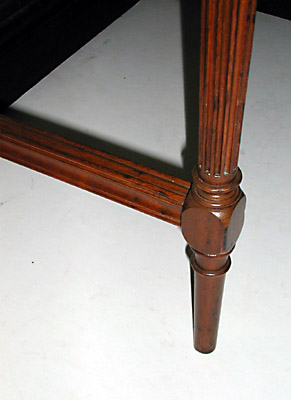 |
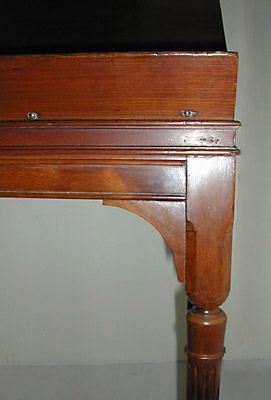
The rectangular book rest with rectangular paneled back and triangular paneled sides, the surface canted at an angle and with perpendicular rectangular book stop, raised on a rectangular stand with molded frieze and having four turned flutedcircular tapering leg united by an open stretcher, ending in circular tapering feet.
An attractive floor standing dictionary stand, useful for displaying an opened dictionary, atlas, or folio book. It was possibly designed as a lectern, and can be used for that purpose as well.
By repute, this dictionary stand was made for the Rittenhouse Club, Philadelphia, Pennsylvania, one of the city's oldest social clubs. It was acquired by the former owner, a member of the club, from an auction of the club's property. While the club has disbanded, its building at 1811 Walnut Street remains, and has been designated a historic building. About the club, J. Thomas Jable writes:
"While occupational success was one measure of prestige in nineteenth-century Philadelphia, perhaps the highest indicator of one's status in society was proper social club affiliation. In mid-Victorian Philadelphia, there were two exclusive social clubs--the Philadelphia and the Rittenhouse. Both attracted aspiring businessmen and professionals, though admission to the Philadelphia was extremely difficult because its admission policy was based largely on...heredity. The younger Rittenhouse Club, nouveau riche in orientation, admitted members on the basis of occupational and social achievement...[Young men] upon securing employment in the business or professional world, strived to advance their social position by seeking admission to one of the city's two exclusive social clubs."
Reference:
Jable, J. Thomas "Crickets, Clubs and Class in Philadelphia: 1850-1880." Los Angeles: NASSH Proceedings, 1988. http://www.aafla.org/SportsLibrary/NASSH_Proceedings/NP1988/NP1988n.pdf (5 March 2002).