Gavel from the Washington Elm
Cambridge, Massachusetts: 1924
Turned elmwood
7.5 inch long, 4 inches wide, 2 inches diameter (head)
Sold, please inquire as to the availability of similar items.

Relic Gavel from the Washington Elm
Cambridge, Massachusetts: 1924
Cambridge, Massachusetts: 1924
This item is sold. It has been placed here in our online archives as a service for researchers and collectors.
- Please inquire as to the availability of similar items currently in stock, or use the navigation bar above to browse our site for currently available items.
- Find guidelines for the use of images from georgeglazer.com.
- To see more archived items, view our directory.
- Find information about selling your art and antiques.

 |
 |
 |
A turned relic gavel made in 1924 from wood from the so-called Washington Elm in Cambridge, Massachusetts. The Washington Elm was a tree on Cambridge Common in Cambridge, Massachusetts, that lived approximately 210 years and died in 1923. The tree fell over and was cut down in 1923, then sliced into pieces that were sent to the capitals of 48 states, the White House, the Capitol, and prominent citizens across the country. These were made into souvenirs, including turned gavels. Today, a plaque embedded in the pavement of Garden Street at its Mason Street intersection marks where the tree used to stand.
As early as the 1830s, the Washington Elm was held to be the place where George Washington took command of the Continental Army in Cambridge on July 3, 1775. For many years a granite tablet stood at the foot of the elm inscribed with a statement attributed to Henry Wadsworth Longfellow: "Under this tree Washington first took command of the American Army.” The publication of the fictional "eye-witness" journal The Diary of Dorothy Dudley in 1876 furthered the legend. Although George Washington did accept the command in Cambridge, there is no official documentation that the event took place under this particular tree. Nonetheless, images of the elm entered popular culture and appeared in prints and art and on souvenir items such as teacups. In 1925, Samuel F. Batchelder delivered a paper to the Cambridge Historical Society debunking the legend. Today, the Cambridge Historical Commission calls the association of Washington and the elm a "myth," but states that "the image of the tree remains a symbol of patriotism in Cambridge." The Cambridge Historical Society held an exhibition on the Washington Elm in popular culture in October 2014.
Another tree dubbed the "Washington Elm" stood on the U.S. Capitol Grounds in Washington, D.C., until it died in 1948. According to David Lynn, Architect of the Capitol in 1948, an 1882 report by landscape architect Frederick Law Olmstead "endorsed the tradition that this tree … had been planted by George Washington in 1798 when he built his brick house a little to the north of the Capitol." Relic gavels were also made from the wood of that tree (see one on our site).
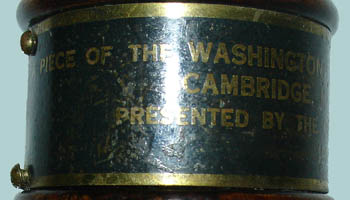
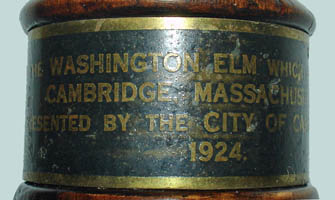
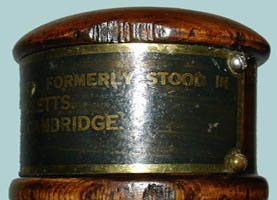
Brass label on gavel head with gold letters on black ground: PIECE OF THE WASHINGTON ELM WHICH STOOD IN/ CAMBRIDGE, MASSACHUSETTS./ PRESENTED BY THE CITY OF CAMBRIDGE./ 1924.
References:
Batchelder, Samuel F. "The Washington Elm Tradition." Proceedings of the Cambridge Historical Society, Vol. 18. 27 October 1925. Online at Cambridge Historical Society: 14 June 2013. http://www.cambridgehistory.org/node/8079 (29 May 2014).
"CHC's Frequently Asked Questions." City of Cambridge. http://www2.cambridgema.gov/historic/faq.html (29 May 2014).
"Washington Elm Exhibit Opening." Cambridge Historical Society. http://www.cambridgehistory.org/content/washington-elm-exhibit-opening (29 May 2014).