Pierre Joseph Buchoz (1731-1807) (editor)
Jacques de Favanne (1716-1770) (after)
C. Baquoy (engraver)
[Alligator]
from Première - séconde centurie de planches enluminées et non enluminées, representant au naturel ce qui se trouve de plus interessant et de plus curieux parmi les animaux, les vegetaux, et les mineraux, pour servir d'intelligence à l'histoire generale des trois regnes de la nature
[First-Second Hundred of Illuminated and Non-Illuminated Plates, Representing in Nature that which Is Found to be the Most Interesting and Curious Among the Animals, the Vegetables, and the Minerals, in Furtherance of Understanding the General History of the Three Realms of Nature]
Lacombe, Paris & Amsterdam: 1775-1781
Hand-colored engraving
9.5 x 13.75 inches, plate mark
13 x 20 inches, overall
Sold, please inquire as to the availability of similar items.

Natural History Study of an Alligator
French 18th Century
French 18th Century
This item is sold. It has been placed here in our online archives as a service for researchers and collectors.
- Please inquire as to the availability of similar items currently in stock, or use the navigation bar above to browse our site for currently available items.
- Find guidelines for the use of images from georgeglazer.com.
- To see more archived items, view our directory.
- Find information about selling your art and antiques.
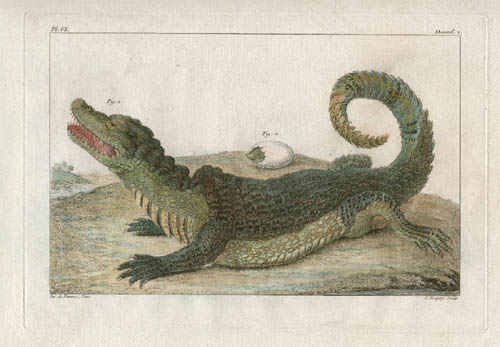
Natural history engraving depicting an adult alligator defending its baby, not yet fully hatched and poking its little snout out of its shell. The adult, shown in profile, bares its teeth and curls its tail in the air in way that owes more to artistic imagination than reality. This is not unusual in 18th century natural history studies, where the artists often did not directly observe the animals they illustrated. The print is from a comprehensive set of natural history studies of the three kingdoms of nature -- animals, plants, and minerals.
Pierre Joseph Buchoz (also spelled Buc'hoz), was a French physician and naturalist as well as an extremely prolific author of natural history books in the latter half of the 18th century, with a particular emphasis on copiously illustrated sets of botanicals. Born in Metz, he served at various times as physician to the King of Poland, the brother of the King of France, and the Duke of Artois. Buchoz was a member of academies in France and Europe and his monumental Histoire Universelle du Règne Végétal ([1774-]1775-1780) — with 1,200 botanical engravings — earned the approval of the Academy of Science. Some of the plates in his works were apparently derived from those in works by others (such as de Sève) and Buchoz also managed to be so prolific because he often adapted text and material between and among his own works. Nonetheless, the overall quality of his prints is comparable to the best European and English natural history works of the same period in their great attention to composition and scientific detail, and in the quality of the engraving and coloring. Indeed, Buchoz also had the distinction of producing the first European florilegium in which a large number of the images were of flowers grown in Chinese gardens, and which widely incorporated the so called “Chinoiserie” style, in Collection Précieuse et Enluminée des Fleurs les Plus Belles et les Plus Curieuses (1776-79).
Jacques de Favanne was a French draftsman and engraver from Paris. He was the son of the French painter Henri-Antoine de Favanne and a student of F. Thomassin. He produced engravings after Watteau, Lancret and Le Maine, as well as producing book illustrations, including natural history illustrations for works such as La Conchyliologie ou Histoire Naturelle des Coquilles de Mer… byDezallier d'Argenville.
C. Baquoy also produced natural history engravings for the natural history encyclopedia of Georges-Louis Marie LeClerc, Count of Buffon.
References:
Bénézit, E. Dictionnaire critique et documentaire des Peintres, Sculpteurs, Dessinateurs et Graveurs. France: Librairie Gründ, 1966. Vol. 3, p. 686 (de Favanne).
Blunt, Wilfred, rev. by Stearn, William T. The Art of Botanical Illustration. Woodbridge, Suffolk, England: Antique Collectors Club, 1994. pp. 175, 178-9 (Buchoz).
"Buchoz, Pierre-Joseph." Fonds Patrimonial du SCD de l'Université Rennes 2. http://www.uhb.fr/scd/fonds/buchoz1.htm (28 January 2004).
Poppe, Guido T. and Poppe, Philippe. “Histoire d’Argenville: La Conchyliology -- 1757.” Conchology, Inc. 1996-2004. http://lasso.conchology.be/Cyberconchology/oldBooksDArgenville.html (5 January 2005).