Port Jackson Painter, et al.
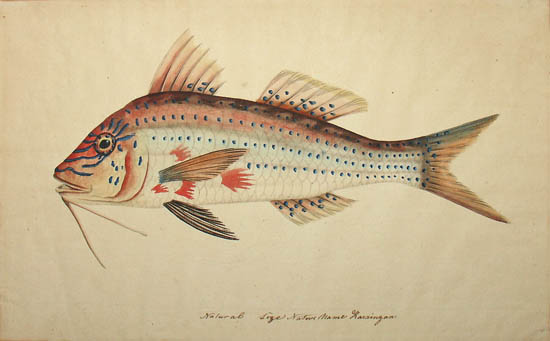
[Blue-striped Goatfish]
British: c. 1788-1797
Watercolor on laid paper
7 x 11.25 inches, overall
13 x 17.25 inches in custom frame
Sold, please inquire as to the availability of similar items.

Blue-striped Goatfish
Late 18th Century Watercolor of Australian Fish
Late 18th Century Watercolor of Australian Fish
This item is sold. It has been placed here in our online archives as a service for researchers and collectors.
- Please inquire as to the availability of similar items currently in stock, or use the navigation bar above to browse our site for currently available items.
- Find guidelines for the use of images from georgeglazer.com.
- To see more archived items, view our directory.
- Find information about selling your art and antiques.
 |
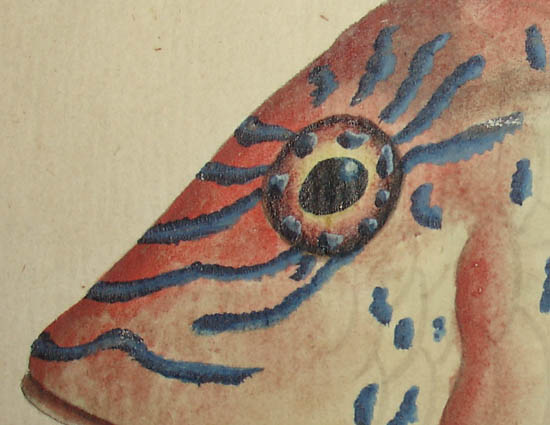 |

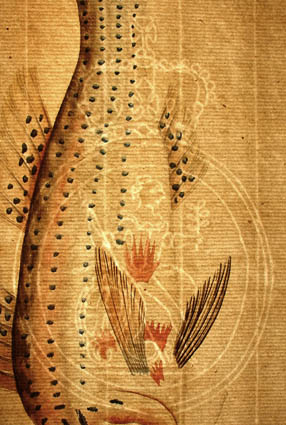
Above are three details: The watermark, with contrast enhanced to show the design (upper left), the painting (upper right), and the inscription.
 |
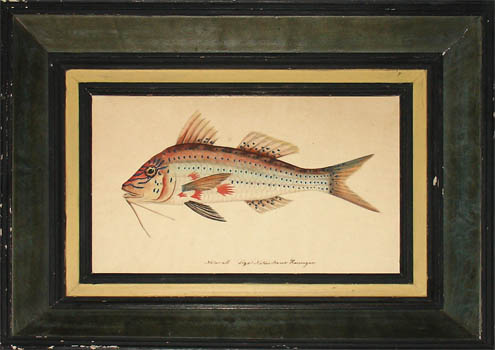 |
Late 18th century natural history watercolor study of an Australian fish from the great age of British exploration and settlement in Australia. An inscription in brown ink indicates that the fish was painted at actual size and gives its "native name," presumably in the language of the aboriginal Eora Nation. The inscription is similar in handwriting and format to those found on a group of natural history watercolors in the First Fleet collection of the Natural History Museum (London), which includes paintings of fish found in the waters of Port Jackson, Australia, (present day Sydney) by both named and anonymous artists. The museum refers to one of the artists as the "Port Jackson Painter,” and dates them between 1788 and 1797.
The artists of the First Fleet collection were the first British settlers who arrived in Australia to establish a colony, in 1788. They drew the flora and fauna and the native people of the Eora Nation, documenting many species previously unknown in the West. Although the artists were not trained in scientific illustrations and did not always adhere to standards of scientific accuracy, their drawings remain an important record and include species that have since become extinct. The Natural History Museum in London has over 600 drawings in its First Fleet collection, 507 of which depict animals and plants. Collectively, they are an important scientific record of the Age of Enlightenment, when various plant and animal species were first classified in accordance with the system developed by Linneaus.
The blue-striped goatfish (Upeneichthys lineatus), also known as blue-striped mullet, is colored with characteristic red-orange and blue markings. It is now found in sheltered bays and harbors along the southeastern coast of Australia, including the vicinity of Sydney.
Inscription: Natural Size Native Name Karringan [or Tharringan]
Watermark: On laid paper, characteristic of the period, watermarked with a seated figure of Britannia holding an olive branch and a shield within an oval surmounted by a crown.
References:
"Blue-striped mullet (Upeneichthys lineatus)." Encyclopedia of Life. http://eol.org/pages/1012868/entries/20793860/overview (1 March 2012).
“First Fleet Artwork Collection.” Natural History Museum, UK. http://www.nhm.ac.uk/nature-online/art-nature-imaging/collections/first-fleet/art-collection/nathist.dsml?sa=1&disp=list¬es=true&desc=true (29 February 2012).