
Georg August Goldfuss, Dusseldorf: 1824-1843
This item is sold. It has been placed here in our online archives as a service for researchers and collectors.
- Please inquire as to the availability of similar items currently in stock, or use the navigation bar above to browse our site for currently available items.
- Find guidelines for the use of images from georgeglazer.com.
- To see more archived items, view our directory.
- Find information about selling your art and antiques.
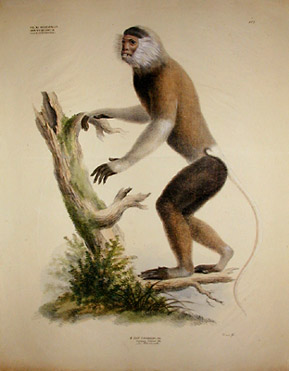
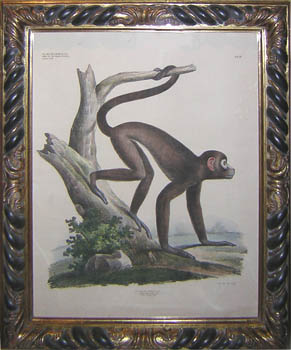
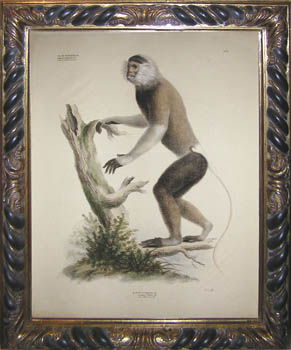
Lasiopyga Nemaea |
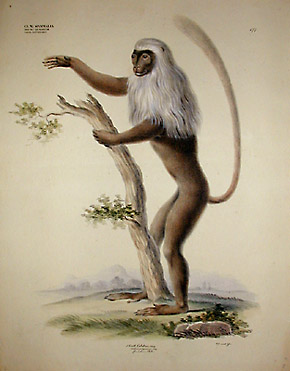
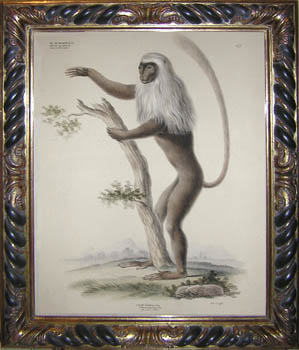
Colobus Polycomos |
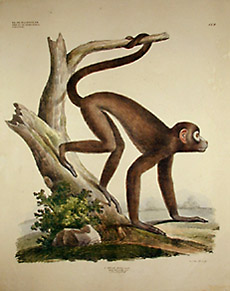
Ateles Belzebuth |
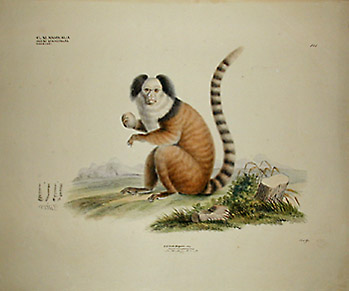
Hapale Leucocephalus |
 |
 |
 |
Georg August Goldfuss (1782-1848) |
 |
Four large natural history primate studies from a large series of natural history lithographs. Each lithograph depicts a species of monkey in a different stance -- three grasping tree stumps and one seated on the ground holding an egg. They are realistically and sensitively portrayed, each monkey with its own temperament and personality. Goldfuss’s Naturalist Atlas comprised 452 lithographs released by subscription over two decades. The three vertical prints are each custom framed in an elaborate Renaissance-style giltwood and ebonized frame.
The primates in these plates are identified according to the Linnaean system. These four monkeys are from class XI Mammalia, order XV Quadrumana/Quadrum. Two plates (182, 177) are from family III, Cercopitheci with labels Gatt. Colobus/ Colobus polycomos, and Gatt. Lasiopyga/ Lasiopyga Nemaea. The other two plates (145, 149) are from family II, Cebi, and are labeled Gatt. Hapale/ Hapale leucocephalus, and Gatt. Ateles/ Ateles Belzebuth. The source of these images is possibly Johann Christian Daniel von Schreber's (1739-1810) monumental study of primates, Die Saugthiere in Abbildungen nach der Natur mit Beschreibungen (1775-1792). For example, the print of Colobus polycomos is an enlarged version of the same image that appeared in Die Saugthiere. It was a fairly common practice for images from natural history works to appear in subsequent publications.
Georg August Goldfuss was a German paleontologist, zoologist and professor. In 1804 he received his doctorate from the University of Erlangen with a thesis on a South African beetle. He also did field research in South Africa. From 1811 to 1818 he was a teacher and administrator in the zoology department at Erlangen. At this time he also became interested in the newly discovered fossils, and was one of the early German paleontologists. In 1818 he introduced the concept of protozoa in science. He was admitted to the Leopoldina, the oldest society of science and medicine in Germany and was made a secretary of the organization in charge of the library and specimen collections. Concerned about the decline of the University at Erlangen, he and others engineered the transfer of the Leopoldina collections to the Rheinische Friedrich-Wilhelms University of Bonn, where he became professor of paleontology and mineralogy. A prolific author, he published numerous books and articles on zoology, and identified new species such as the koala and the Cervidae (deer). Goldfuss is renowned for his major study of invertebrate fossils found in Germany, Petrefacta Germaniae (1826-1844), which remained unfinished at his death, and for Naturhistorischer Atlas [Naturalist Atlas] (Dusseldorf: 1824-43), a comprehensive illustrated study of animals.
Reference:
“August Goldfuß.” Wikipedia. 9 August 2008. http://de.wikipedia.org/wiki/Georg_August_Goldfu%C3%9F (16 September 2008).