Francis Hatch Kimball (1845-1919) (architect)
Hughson Hawley (1850-1936) (artist)
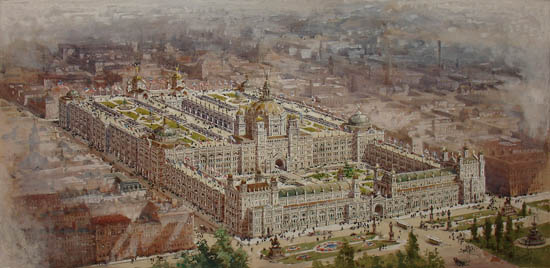
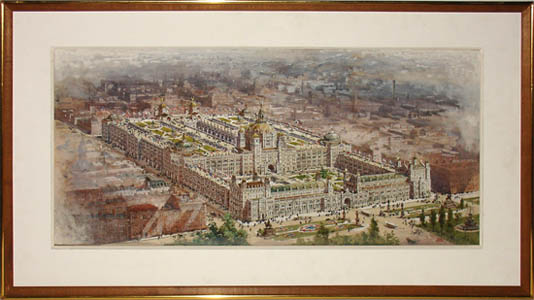
Suggestion for Permanent Exhibition Building for Merchant's Association
New York: c. 1903
Gouache, watercolor, and pencil on illustration board
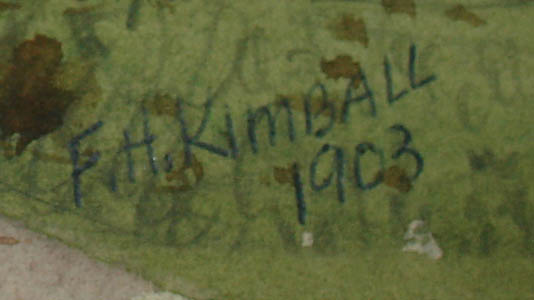
Signed F.H. Kimball and dated lower right, title on label verso
13.75 x 29.25 inches, mat window
14.25 x 30 inches, overall
20.75 x 36.25 inches, in gold frame with linen mat liner
Provenance: Ralph Esmerian Collection, New York
Sold, please inquire as to the availability of similar items.

Rendering of Proposed Merchant's Association Building
Francis Hatch Kimball & Hughson Hawley, 1903
Francis Hatch Kimball & Hughson Hawley, 1903
This item is sold. It has been placed here in our online archives as a service for researchers and collectors.
- Please inquire as to the availability of similar items currently in stock, or use the navigation bar above to browse our site for currently available items.
- Find guidelines for the use of images from georgeglazer.com.
- To see more archived items, view our directory.
- Find information about selling your art and antiques.
 |
 |
 |
 |
 |
 |
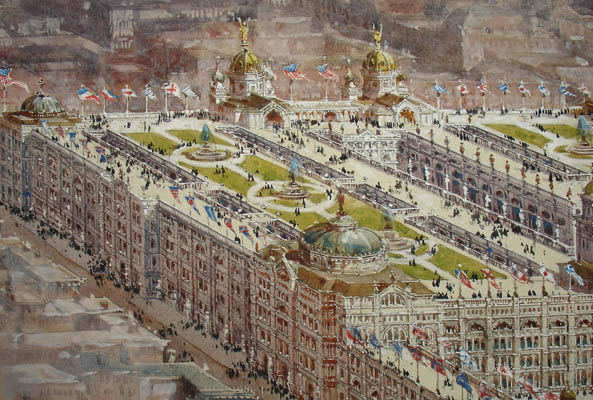
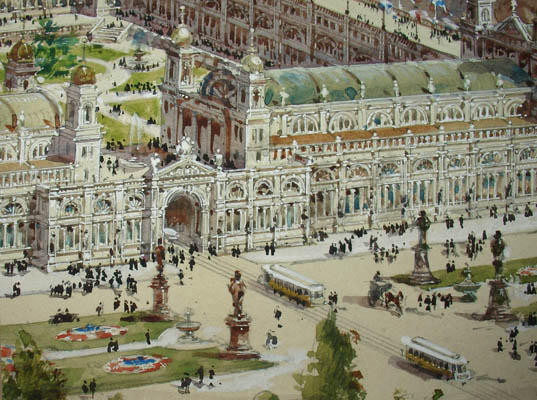
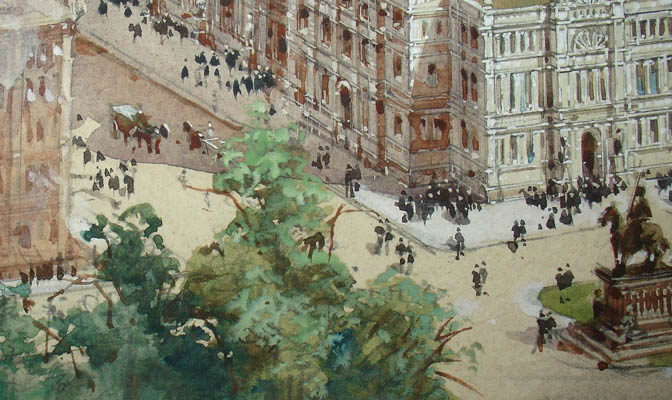
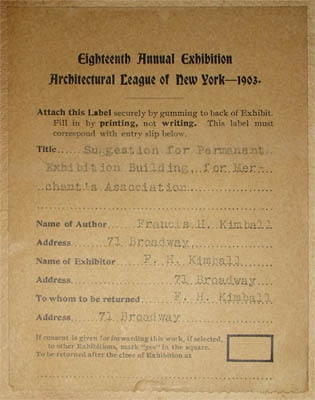
Rendering of a design for a grand exhibition hall in the Beaux-Arts style. The huge structure fills an entire square block, with courtyards containing formal gardens and a large dome in the center. The elaborate architecture also incorporates columns, arches, and Diocletian windows. It is signed by the highly regarded and successful New York architect Francis Hatch Kimball and retains its exhibition label on the backside from the 18th Annual Exhibition of the Architectural League of New York. This large exhibition included about 1,000 designs by distinguished architects and designers of architectural decorations of the era. The original exhibition catalog refers to this work by Kimball as entry number 614 and credits "H. Hawley" as the artist, referring to the renowned and prolific New York architectural renderer Hughson Hawley. Hawley and Kimball's professional relationship began in 1880, when Kimball and his partner discovered Hawley working as a theatrical scene painter and encouraged him to pursue a career as an architectural renderer. Hawley produced many of Kimball's renderings for the next 33 years.
The design was likely intended as a proposal for a magnificent building in Chicago. An 1899 issue of The American Architect and Building News recounts:
"Some of the prominent clubs in the city, notably the Merchants' Association, brought together at a banquet many men of many minds to talk the matter over. There was an attempt to keep many minds in order by avoiding any discussion of the subject of site or actual plans, the main question being, Do we want an exhibition building? The chief query was unanimously answered with a 'Yes, one of the $2,000,000 kind, bigger, of course, than the Madison Square Garden in New York, the Crystal Palace in London, the Hippodrome building in Paris.' Ministers, doctors, educators, railroad magnates, merchants and financiers were all gathered at the banquet to tell why, from different standpoints, Chicago needed such a great and glorious structure."
Kimball’s meticulous design, executed just 4 years later, clearly qualifies as a huge and opulent building as was contemplated in 1899, dramatically shown in the rendering radiantly standing out from the surrounding city buildings.
Francis Hatch Kimball was a prolific and influential architect in the early high rise history of New York City, especially Lower Manhattan. According to organizers of a 2007 symposium on Kimball at New York's Skyscraper Museum, his historicist approach incorporating styles from Gothic and Renaissance to Beaux-Arts "helped to define a distinctive 'New York School'" of architecture at the turn of the century. Kimball began his architectural career in Boston. His first major project was as supervising architect on buildings designed by London architect William Burgess for Trinity College in Hartford, Connecticut. In preparation, he traveled to London and studied Gothic architecture. In 1879 he joined the practice of New York architect Thomas Wisedell for five years, designing additional buildings at Trinity College, and establishing a reputation in theater design. From 1892 to 1898, he worked in partnership with G. Kramer Thompson as Kimball and Thompson. The firm designed several buildings in Manhattan, including the Manhattan Life Insurance Building, the tallest building in the U.S. upon its completion in 1894; the Rhinelander Mansion (on Madison Avenue, now the New York City flagship store of Polo Ralph Lauren); the Standard Oil Building; and the Empire Building at 71 Broadway, where he opened his own architectural firm in 1898. He continued designing New York City skyscrapers including 21-story office buildings at 111 Fifth Avenue and 111 Broadway, and the 32-story Adams Express Buildings on lower Broadway and Trinity Place into the 1910s.
Hughson Hawley, a British-born architectural renderer, enjoyed a 50-year career in New York City, producing thousands of drawings during one of the great eras of American architecture, when the first skyscrapers were being constructed. He began as a theatrical set painter in his native England, moving to New York City in 1879 to paint scenery at the Madison Square Theater at the invitation of the owner. With the encouragement of the architects Francis H. Kimball and Thomas Wisedell, who had been commissioned to remodel the theater, Hawley opened an architectural rendering studio in 1880. Architects use drawings of proposed buildings to persuade prospective clients, but Hawley’s artistic and architectural skills were so extraordinary that his drawings were frequently reproduced as lithographs, advertisements, brochures and letterheads to promote the completed buildings. His style was even imitated by others. In addition to working for architects, Hawley created illustrations for publications such as Harper’s Weekly, Harper’s New Monthly Magazine, Century and exhibited at the National Academy of Design, the American Watercolor Society and on a regular basis at the Architectural League, the premiere showcase for architects and designers at the time. He retired to England in 1931 at the age of 81, and spent the remainder of his life there. Hawley's architectural renderings were the subject of an exhibition and catalog at the Museum of the City of New York in 1998, which has many of his works in their collection. They are also in the collections of the Avery Architectural and Fine Arts Library at Columbia University and the New-York Historical Society.
Label verso: The title and Kimball's name and address are typed on a label attached verso for the Eighteenth Annual Exhibition, Architectural League of New York in 1903.
References:
Catalogue of the Eighteenth Annual Exhibition of the Architectural League of New York. New York: Architecture Press, 1903. p. 45. Online at Google Books: http://books.google.com/books/reader?id=7HEXAQAAIAAJ (27 January 2012).
"Chicago: The Suggested Exhibition Building." The American Architect and Building News, Vol. 63, No. 1206. February 4, 1899. p. 36. Online at Google Books: http://books.google.com/books?id=JopMAAAAYAAJ (27 January 2012).
"Francis Hatch Kimball." Lehman College Art Gallery: Bronx Architecture. http://www.lehman.edu/vpadvance/artgallery/arch/bio/kimball.html (26 January 2012).
"Francis Hatch Kimball." Mark Twain's Neighborhood Nook Form. 2007. http://www.fingerpostproductions.com/nook_farm/pages/kimball.html (26 January 2012).
Parks, Janet, Rob Del Bagno and Frederic A. Sharf. New York on the Rise: Architectural Renderings by Hughson Hawley, 1880-1931. New York: Museum of the City of New York, 1998. pp. 7-9, 16, 39, 44-45, 50-62.
Sharf, Frederic A. “Discovering Hughson Hawley.” Museum of the City of New York. http://www.mcny.org/Exhibitions/Hawley/hawley3.htm (3 November 2004).
"Symposium: Francis Hatch Kimball and the Early New York Skyscraper." The Skyscraper Museum. 1997-2011. http://www.skyscraper.org/PROGRAMS/kimball_symposium.htm (26 January 2012).