Pietro Camporesi (after)
Giovanni Volpato (engraver)
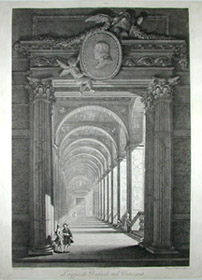
Frontispiece
from Loggia di Rafaele nel Vaticano
Rome: 1772-77
Etching with engraving on paper
24.75 x 19.5 inches, sheet
22.5 x 15.5 inches,image excluding text
Provenance: Dr. and Mrs. Edgar P. Richardson, Philadelphia, Pennsylvania
Sold, please inquire as to the availability of similar items.

Architectural Frontispiece
from Loggia di Rafaele nel Vaticano, 1772-77
from Loggia di Rafaele nel Vaticano, 1772-77
This item is sold. It has been placed here in our online archives as a service for researchers and collectors.
- Please inquire as to the availability of similar items currently in stock, or use the navigation bar above to browse our site for currently available items.
- Find guidelines for the use of images from georgeglazer.com.
- To see more archived items, view our directory.
- Find information about selling your art and antiques.
 |
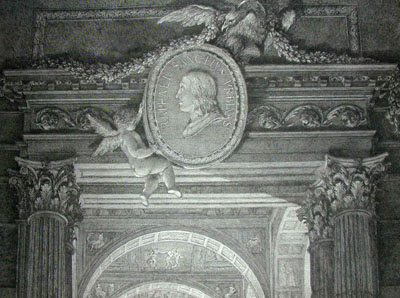 |
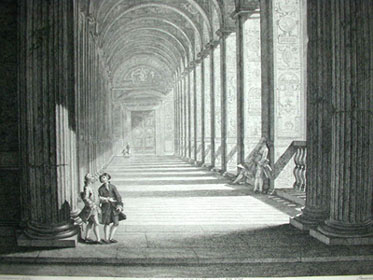
This is the frontispiece to the splendid 83-plate survey of the ornamental frescoes designed by Raphael for the Vatican Loggia, an open-sided vaulted gallery. A medallion bust profile portrait of Raphael surrounded by a festooned eagle and a cupid surmounts the view. The loggia's entrance is flanked by large columns, and the Renaissance frescoed pilasters and arches are visible. Pedestrians in 18th Century dress provide a sense of scale.
As a whole, the collection of prints published as Loggia di Rafeale nel Vaticano is comprised of a series of architectural studies of walls, ceilings, arches, and doors designed by Raphael for Pope Leo X's private loggia in the Vatican. They incorporate frescoes with classical mythological images as well as renderings of biblical stories (known as "Raphael's Bible") amidst a variety of classical and grotesque ornament. In the neoclassical era of the late 18th Century, there was considerable interest in classical themes in Renaissance art. This set was intended as a source book for architects and designers, as well as a decorative picture book for Grand Tour travelers. In particular, this work stimulated interest in Renaissance grotesque ornament.
Raphael was one of the three greatest artists of the Italian High Renaissance and an accomplished architect as well. As chief archeologist to the Pope, he was involved in the excavation of the ancient Golden House of Nero, and adapted many of the elaborate Roman frescoes he saw there in creating his own innovative painted wall and ceiling designs in the Vatican and private villas in Rome. Prints made after Raphael’s drawings, designs and paintings were produced during his lifetime by the engraver Marcantonio Raimondi (c.1470-1482 - c. 1527-1534). Raphael prints by other engravers were especially popular in the neoclassical period of the mid 18th century and early 19th century coinciding with the tremendous revival of interest in the classical art of ancient Greece and Rome, as well as the classicism of the Renaissance. Some of these prints served as references for architects and designers because many were based on frescoes that had been incorporated into interior architecture. This interest in Raphael, often reflected in prints, continued throughout the 19th century as he achieved legendary status.
Among the more famous prints after Raphael are series from the late 18th century illustrating his frescoes in the Vatican stanze (notably Picturae Raphaelis Sanctii Urbinatis,Rome: 1722); the Vatican loggia (notably Loggia di Rafaele nel Vaticano, Rome: 1772-77) and the Villa Farnesina in Rome (notably Psyches et Amoris Nuptiae ac Fabula, Rome: 1693). One popular set, variously issued as engravings and lithographs during the 19th century, shows details of Raphael’s allegorical frescoes of 12 hours of the day and night. A related set of engravings depicts the gods and goddesses of the Roman pantheon riding in chariots in their heavenly domain, probably representing the seven days of the week.
The prints in this set are based on renderings by the painter Gaetano Savorelli and the draughtsman Ludovico Teseo. Pietro Camporesi (1726-1781), a Roman architect who worked for Pope Clemens XIII and Pius VI on rooms for the Vatican Museum, also contributed to the work and designed the frontispiece. The prints were etched and engraved by Giovanni Ottaviani and Giovanni Volpato (1740-1803). These artists took some liberties in borrowing elements from Raphael's Vatican tapestries to fill in elements that were illegible in the original frescoes due to deterioration over time. Thus, the prints are amalgam of actual and supposed design elements of Raphael.
References:
"Raphael Invenit: Stampe da Rafaello" (1985) Volpato 1; Ottaviano 2-19 and Dorigny 37-46. Brunet IV, cf.1110 & 1111; Berlin "Kat". Cf.4068 & 4066; "Raphael: Reproduktions-graphik aus vier Jahrhunderten (Coburg 1984) p.104 & no.245; "Giovanni Volpato 1735- 1803" (Bassano del Grappa, 1988) 173.