Giovanni Battista Piranesi (1720-1778) (artist and etcher)
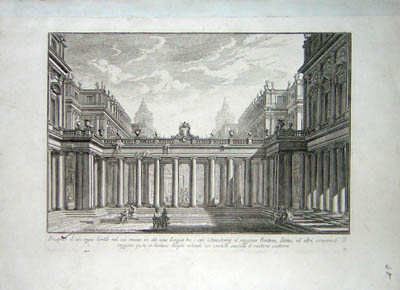
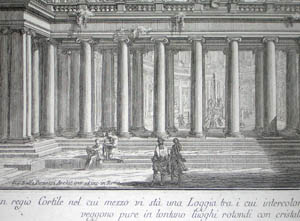
Prospetto d’un region Cortile nel cui mezzo vi stà una Loggia
[Prospect View of a Courtyard Space in the Center of Which Is a Loggia, Wilton Ely No. B.1 – 12]
Ponte magnifico con Logge
[Magnificent Bridge with Loggias, Wilton Ely No. B.1 – 8]
from
Prima Parte di Architetture e Prospettive
[First Part of Architecture and Prospect Views]
Fratelli Pagliari, Rome: 1743
Issued in
Opere Varie di Architetture:
Rome: c. 1750
Black-and-white copperplate etchings and engravings
14 x 19.5 inches, overall approximate
9.5 x 14 inches, image approximate
Sold, please inquire as to the availability of similar items.
To see other Piranesi prints on our site, use our site search engine.
Pair of views of ancient Rome, by Giovanni Battista Piranesi, from his first work. These architectural fantasies are in the Venetian landscape style based on actual ruins. Piranesi scholar John Wilton-Ely explains the purpose of the work:
Keenly critical of his contemporaries’ failure to measure up to the ruined grandeur surrounding them, [Piranesi] undertook an act of creative interpretation using the past as a stimulus to the imagination. Piranesi already shows in this work many of the chief ingredients of his art-- the unorthodox combination of classical motifs, the manipulation of superhuman scale, the organization of powerfully receding perspectives upon diagonal axes, and the modulation of space by means of skilful lighting.
Wilton-Ely’s catalogue raisonné of Piranesi’s etchings lists these two prints as follows, with translation of titles, and references to other editions and scholars:
Ponte magnifico con Logge, ed Archi eretto da un Imperatore Romano… [Magnificent bridge with loggias, and arches erected by a Roman Emperor…] (IV. Ponte coperte di Loggie, ed Archi. Bridge covered by loggias, and arches.) Signature, lower left, in the image. 240 x 360 mm. F7, C335b, R6(v).
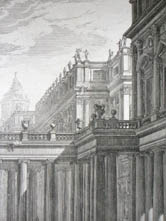
Prospetto d’un region Cortile nel cui mezzo vi stà una Loggia tra I cui intercolonni si veggono Fontane, Statue, ed altri ornamenti. Si veggono pure in lontano luoghi rotondi con cristalli second oil moderno costume. [Royal courtyard in the center of which is a loggia with fountains, statues, and other ornaments among the columns. In the distance are rotundas with skylights according to the modern fashion.] (IX. Cortile circondato da Portici. Courtyard surrounded by porticos.) This design includes a fanciful variation on Borromini’s S. Ivo della Sapienza in Rome, the spiraling tower of which is duplicated on the horizon. 235 x 355 mm. FII, C337b, R10(v).
According to Wilton-Ely, Prima Parte was issued in 1743, and again in 1750 as part of the combination volume known as Opere Varie di Architetture (which included plates from various Piranesi editions to date). This offered pair of prints are from Opere Varie, since the original edition of Prima Parte apparently did not have the lengthy titles printed below the image. In addition, the offered pair are numbered in manuscript 39 and 40 and there are only 16 prints in the standard original edition of Prima Parte (and 5 additional plates issued for Prima Parte in Opere Varie). This further suggests that they were part of the larger work.
Giovanni Battista Piranesi was a multi-talented and accomplished man of the enlightenment who combined supreme artistic ability and historical scholarship with an entrepreneurial business sense. He was at once an artist, architect, archeologist, designer, collector, and print and antiquities dealer. Many consider him one of the most influential artists in the development and popularization of the neoclassical style of the late 18th Century. According to scholar John Wilton-Ely, the distinguishing characteristics of Piranesi’s early works were “the unorthodox combination of classical motifs, the manipulation of superhuman scale, the organization of powerfully receding perspectives upon diagonal axes, and the modulation of space by means of skilful lighting.” Piranesi’s work was recognized with his election as a Fellow of the Society of Antiquaries in England in 1757. He was knighted by the Pope in 1765. Although Piranesi composed and etched many of his works, his son Francesco (1758-1810) and studio assistants such as Vincenzo Dolcibene also etched a significant number of the prints, especially in later years.
Piranesi etched and published numerous folio print sets of art, architecture and archaeology of Rome and environs, that served as source material for other architects and designers. They were sold as souvenirs to English aristocrats on the Grand Tour in Italy or by subscription directly to British patrons. Among those influenced by Piranesi was the great British architect Robert Adam (1728-92), who was a colleague of Piranesi while in Rome on the Grand Tour in the 1750s. From the 1760s onward, Piranesi supplemented his printing business by joining the thriving trade in the restoration and sale antiquities to Grand Tour travelers. Piranesi's interest in these objects went well beyond historical restoration and marketing -- he also advocated emulating the creativity of the Roman designers and integrating motifs from Greek and Roman antiquities with a contemporary sensibility to produce new and strikingly original works. The British were particularly good customers, so he set up his workshop and showrooms close to the British quarter of Rome. After Giovanni Battista Piranesi’s death in 1778, Francesco and another son, Pietro, continued to republish Piranesi prints and sell antiquities.
Reference:
John Wilton-Ely. Giovanni Battista Piranesi: The Complete Etchings. San Francisco: Alan Wofsy Fine Arts, 1994. 2 volumes. Chapter B.I, Volume 1, pp. 18-39.