Joseph Woods (editor)
James Stuart (1713-1788) and Nicholas Revett (1720-1804) (notes and sketches)
W. Pars et al. (after)
T. Baxter, J. Davis et al. (engravers)
T. Bensley (printer)
The Antiquities of Athens, Vol. IV
J. Taylor, High-Holborn, London: 1816
Folio, 21.5 x 15.5 inches, overall
Later rebound in red cloth covers
86 black and white architectural engravings,
plus engraved portrait of Revett
Sold, please inquire as to availability of similar items

The Antiquities of Athens, Vol. 4
Stuart and Revett
Stuart and Revett
This item is sold. It has been placed here in our online archives as a service for researchers and collectors.
- Please inquire as to the availability of similar items currently in stock, or use the navigation bar above to browse our site for currently available items.
- Find guidelines for the use of images from georgeglazer.com.
- To see more archived items, view our directory.
- Find information about selling your art and antiques.
 |
 |
 |
 |
 |
The fourth volume from one of the most important architectural travel works of the 18th and 19th centuries and the first accurate survey of classical Greek architecture in Athens, made by two British architects. The Antiquities of Athens was a highly influential work and one of the foundations of Grecian Revivalist style in England. James Stuart, one of the co-authors, was among the first British architects to utilize neoclassical designs in his garden buildings and interiors, directly relying on the Greek architecture included in the books. The fourth volume was written and published posthumously, in Regency England at the height of the later architectonic revival of classicism in English architecture and decorative arts.
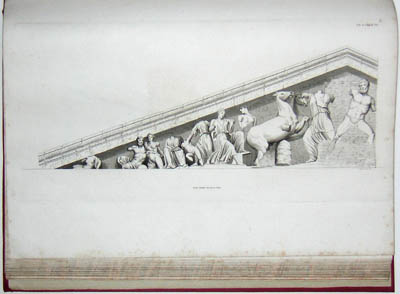
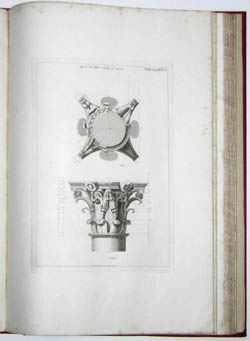
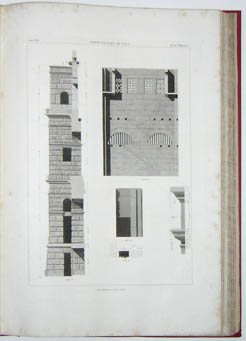
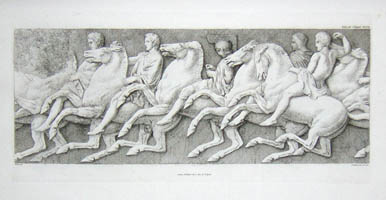
In his preface, editor Joseph Woods described the background and purpose of this publication. He noted that the specimens of the fourth volume were far too interesting and related to the previous works to go undocumented. Additionally, he pointed, out this book focuses solely on the antiquities of Athens, unlike the more varied previous volumes. The majority of Volume IV is devoted to the sculpture of the Parthenon. There are also shorter chapters on Ruins of Pola: the Ampitheatre; the Temple of Rome and Augustus; and the Arch of Sergii. The work also contains observations on previous volumes and an index. Volume IV is notable for containing detailed plates of the Parthenon marbles, including the lost fragments. Coincidentally, it was published the same year in which Elgin sold them to the British Museum.
This work is illustrated with 86 engraved plates, some full shaded engravings, some line engravings. They show architectural elements, fragments, floor plans, etc., including View of the Rock at Delphi, Theatre of Bacchus, Internal View of the Amphitheatre at Pola. There are also smaller engraved architectural details incorporated on text pages, and a portrait of Revett.
Both James Stuart and Nicholas Revett began their careers as painters. Having each independently made their way to Rome, they met there in 1742, and in 1748 the two went together to Naples to study Greek monuments. Stuart felt that contemporary architecture should be modeled on that of ancient Greece, as opposed to Roman examples, and the two men issued proposals to raise funds undertake a "new and accurate description of the Antiquities &c. in the Province of Attica." Under the auspices of the Society of Dilettanti, and with funds raised from other patrons, Stuart and Revett completed the initial survey for The Antiquities of Athens between 1751 and 1754, taking accurate measurements and making drawings of the ruins of Athens, especially the Acropolis, which became the subject of Volume II. Stuart contributed the topographical views and text, Revett the measured drawings.
Stuart was among the first accomplished English architects to execute neoclassical designs for garden buildings and interiors, directly relying on the Greek architecture illustrated in The Antiquities of Athens, which earned him the nickname "Athenian Stuart." These include his garden pavilion "The Temple of the Winds" at Mount Stewart, Northern Ireland, based on the Tower of the Winds, and his designs for a candelabrum based on the Choragic Monument of Lysicrates.
After Stuart left Greece in 1754, Revett attempted to continue his research in other parts of the country under dangerous conditions -- at one point pirates kidnapped him. He stayed in London from 1755 to 1764, when he agreed to accompany another British expedition sponsored by the Dilettanti to Ionia, where he spent two years drawing the antiquities, the results of which were eventually published as The Antiquities of Ionia in 1769 and 1797. He also published Balbec and Palmyra. His major architectural design was the Church of Ayott St. Lawrence, Herts, which was influenced by the early architecture of Asia Minor.
The first volume of The Antiquities of Athens was published by John Haberkorn in 1762 and was the only one to be published while both Stuart and Revett were living. John Nichols in London published the second and third volumes after Stuart's death, Volume II in 1789, Volume III in 1794. Volume IV was compiled using Stuart’s papers and published by J. Taylor in 1816. A final supplemental volume was released in 1830 after much delay.
References:
"Basire." The Grove Dictionary of Art. New York: Macmillan. 2000. Artnet.com. http://www.artnet.com/library/00/0067/T006725.asp (4 February 2003).
Bénézit, E. Dictionnaire critique et documentaire des Peintres, Sculpteurs, Dessinateurs et Graveurs. France: Librairie Gründ, 1966. Vol. 7, p. 197 (Revett); Vol. 8, p. 165 (Stuart).
“James Stuart.” The Columbia Encyclopedia, 6th Ed.New York: Columbia University Press: 2001-2005. Bartleby.com. http://www.bartleby.com/65/st/StuartJ.html (31 August 2004).
Redgrave, Samuel. A Dictionary of Artists of the English School: Painters, Sculptors, Architects, Engravers and Ornamentists. London: Longmans, Green, and Col., 1874. p. 336.
Skinner, Robin. "Unpacking Ruins: architecture from antiquity: Stuart – Athens v1-4." University of Otago (New Zealand) Library. 15 January 2003. http://www.library.otago.ac.nz/exhibitions/ruins/case_three.html (6 January 2006).
"Threat to Site of Greek Temple." Originally published in Guardian Newspapers. 31 January 2005. Buzzle.com. http://www.buzzle.com/editorials/1-31-2005-65039.asp (9 January 2006).