John Pine (1690-1756)
A Copy of the Illuminations of a Charter Granted to the Provost & College of Eton By King Henry VI & Confirmed by Act of Parliament.
from The Tapestry Hangings of the House of Lords
London: August 1, 1749
Hand-colored engraving with gilt highlights
13 1/4 x 20 1/2, sheet
11 3/4 x 14, image
Sold, please inquire as to the availability of similar items.

Engraving of the Eton College Charter
John Pine, 1749
John Pine, 1749
This item is sold. It has been placed here in our online archives as a service for researchers and collectors.
- Please inquire as to the availability of similar items currently in stock, or use the navigation bar above to browse our site for currently available items.
- Find guidelines for the use of images from georgeglazer.com.
- To see more archived items, view our directory.
- Find information about selling your art and antiques.
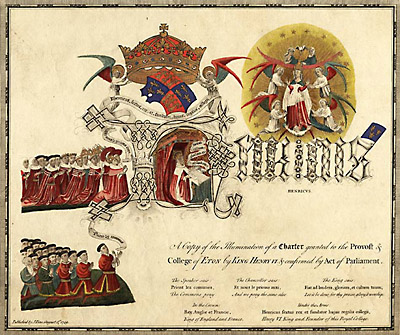

Print by John Pine, admired in Britain as the foremost heraldic and decorative engraver of his generation. His extraordinary skills are displayed in this engraving after a 15th-century illumination.
Eton College was founded by the Royal Charter of Henry V I on September12,1440. According to text in the lower portion of the print:
The Speaker sais: The Commons pray.
The Chancellor sais: And we pray the same also.
The King sais: Let it be done for they praise, glory & worship
In the Crown. King of England and France.
Under the Arms: Henry VI. King and Founder of this Royal College.
Born in London, where he spent his life, John Pine was a close friend of the painter William Hogarth. Described as a cheerful, heavy-set man, he achieved remarkable success and recognition both in his career and socially, becoming London's finest heraldic and decorative engraver and producing numerous book illustrations, including his masterpiece -- an edition of the works of Horace (1733-37) in which he engraved both the text and the exquisite illustrations. It has been said that Pine was the first black man in England to join the Masons. According to Dr. Andrew Prescott, a Masonic scholar at Sheffield University in the U.K., while some, including Pine's descendants, believe he was of Moorish ancestry, there is no clearcut evidence available at this time. However, Pine was indeed active as a freemason, responsible for engraving the annual List of Lodges from 1725 to 1741 as well as The Book of Constitutions, and the social connections resulting from his association with freemansonry brought him important commissions which advanced his career, as well as subscriptions from prominent men to underwrite his Horace project. According to Dr. Prescott, "one of John Pine's greatest qualities was the way in which he was able to blend the artistic skills, the business sense and the sheer social networking which was necessary to be a successful artist in eighteenth-century London."
Pine is listed in the British "Dictionary of National Biography."
Reference:
Arrington, Keith. "The First Black Mason." Phylaxis Society: c. 1974-75. The Dr. Charles H. Wesley Masonic Research Society. http://www.phaohio.org/chwmrs/fbm.html (21 March 2002).
Prescott, Andrew. "John Pine (1690-1756): Engraver and Freemason." Presented at the Canonbury Masonic Research Centre 2001 Conference: The Visual Arts and Freemasonry. Canonbury Tower, Islington, London: 3-4 November 2001.
Prescott, Andrew. "Re: Question about John Pine, Mason and Engraver." E-mail to Helen Glazer. (21 March 2002).