Giovanni Francesco Barbieri, called Guercino (1591-1666) (after)
Francesco Bartolozzi (1727-1815) (etcher)
Gio. Francesco, Barbieri. detto il Guercino da Cento
[Giovanni Francesco, Barbieri, called Guercino of Cento]
from Eighty-Two Prints engraved by Bartolozzi &c from the Original Drawings of Guercino, in the Collection of His Majesty
John & Josiah Boydell, London: c. 1800
Etching with stipple engraving
11.75 x 9.75 inches, image
12.75 x 10.25 inches, plate mark
21.75 x 15 inches, overall
Sold, please inquire as to the availability of similar items.

Guercino Self Portrait
Engraving by Bartolozzi
Engraving by Bartolozzi
This item is sold. It has been placed here in our online archives as a service for researchers and collectors.
- Please inquire as to the availability of similar items currently in stock, or use the navigation bar above to browse our site for currently available items.
- Find guidelines for the use of images from georgeglazer.com.
- To see more archived items, view our directory.
- Find information about selling your art and antiques.

 |
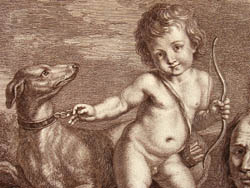 |
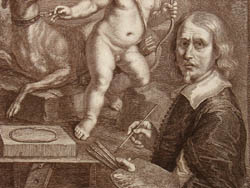
Self-portrait of the famous Italian painter Guercino. The artist depicts himself painting an allegorical scene of Cupid holding a dog by a short chain leash. The image was originally engraved in 1764 by the renowned printmaker Francesco Bartolozzi after the painting by Benedetto Gennari conserved at Windsor Castle, which was a copy of an original by Guercino that has been lost. This print was published in London by the printsellers John and Josiah Boydell as the frontispiece of a series of prints engraved after drawings by Guercino in the collection of the King of England.
George III’s librarian, Richard Dalton, met the great mezzotint engraver Francesco Bartolozzi on a visit to Italy in the 1760s. This led to Bartolozzi coming to England to work on a series of etchings after Guercino in the Royal Collection. Other engravers included Dalton himself, James Basire, Giovanni Vitalba and Lady Louisa Augusta Greville. In 1791, the entrepreneurial London publishers John & Josiah Boydell bought most of the plates and issued them both individually and bound in a single volume.
Giovanni Francesco Barbieri, called Guercino, was an Italian painter and draughtsman -- one of the leading painters of the Bolognese school and among the most accomplished draftsmen of the Italian Baroque. A prolific artist, he painted altarpieces, frescos, large historical paintings and religious works. Born in the town of Cento, he lived for a time in other Italian cities, ending up in Rome, where Pope Gregory XV became his patron. After the pope’s death in 1623, he returned to Cento, where he remained for the next 20 years. Among his most famous works are the frescoes for the Duomo at Piacenza. In 1642, he moved to Bologna, where he spent the rest of his life. Considered one of the Italian masters, his works are in the world’s great museums, including the National Gallery in England, the Louvre in Paris, the Hermitage in Petersburg, and the Vatican in Rome.
Francesco Bartolozzi (1727-1815) was an engraver, etcher and painter born in Florence, Italy. He was trained in the Florentine Academy and apprenticed to a Venetian engraver. In 1764, King George III's librarian, Richard Dalton, brought him to England, where he was appointed Engraver to the King and later held the title of Royal Academician. A prolific engraver, he helped develop a stipple method invented in France, and his work was admired for its subtle modulations of light and shade and his sensitive and graceful portrayal of the human form. Engravings were the means of creating reproductions of fine art in the pre-photographic age, and Bartolozzi was considered one of the best. Prominent artists such as Sir Joshua Reynolds praised his work and his pupils nicknamed him "the god of drawing." Some of Bartolozzi’s engravings after paintings by old masters, such as the works of Guercino, were published (separately issued or bound in volumes) by the London printsellers John and Josiah Boydell, in the late 18th and early 19th centuries. Bartolozzi spent the last 13 years of his life working and teaching in Lisbon, where he was knighted.
John Boydell (1719-1804) was a printseller and engraver. In 1773, his nephew Josiah Boydell (1752-1817) became his business partner (trading as J. & J. Boydell) and later his successor. The Boydells are credited with fostering fine engraving in England with various publications, including scenes from Shakespeare by the best British engravers of the day, etchings by the renowned artist Francesco Bartolozzi (1727-1815) after paintings by Guercino, and a pair of mezzotint still life prints after Jan Van Huysum (1682-1749). Their prolific output includes many other works after old masters, genre scenes, landscapes and views, and maps.
References:
“Giovanni Francesco Barbieri.” The Grove Dictionary of Art. New York: Macmillan. 2000. Artnet.com. http://www.artnet.com/library/03/0354/T035416.asp (27 July 2005).
Hunt, Leigh. "Francesco Bartolozzi." The Catholic Encyclopedia, Volume II. Robert Appleton Company: 1907. Online edition: Kevin Knight: 1999. http://www.newadvent.org/cathen/02319a.htm (27 August 2002).
“John Boydell and Prints in Imitation of Drawings from the Royal Collection.” The Hunterian Art Gallery: Connoisseurs, Collectors and Copyists. http://www.hunterian.gla.ac.uk/Archives/CCCexhib/introboyd.htm (27 July 2005).
Maxted, Ian. “The London book trades 1775-1800: a preliminary checklist of members” UK: Devon County Council, 2001. http://www.devon.gov.uk/library/locstudy/bookhist/lonb.html (12 January 2005).
Rusche, Harry. “Boydell's Shakespeare Gallery.” Department of English, Emory University. 1998. http://www.emory.edu/ENGLISH/classes/Shakespeare_Illustrated/Boydell.html (12 January 2005).
Williamson, George C., ed. Bryan's Dictionary of Painters and Engravers. London: G. Bell and Sons: 1930. Vol. 1, pp. 81-82.