Filippo Arena (1708-1789)
Botanical Prints
from La Natura e Coltura dei Fiori Fisicamente Esposta
[The Nature and Cultivation of Flowers Physically Displayed]
Angelo Felicella, Palermo, Sicily: 1767
Hand-colored engravings
7.75 x 12 inches, platemark
9.5 x 14 inches, sheet
Sold, please inquire as to the availability of similar items.

Filippo Arena Colorful Botanical Prints
Palermo, Sicily: 1767
Palermo, Sicily: 1767
This item is sold. It has been placed here in our online archives as a service for researchers and collectors.
- Please inquire as to the availability of similar items currently in stock, or use the navigation bar above to browse our site for currently available items.
- Find guidelines for the use of images from georgeglazer.com.
- To see more archived items, view our directory.
- Find information about selling your art and antiques.
Plate {plate}
{title}
[{commonname}]
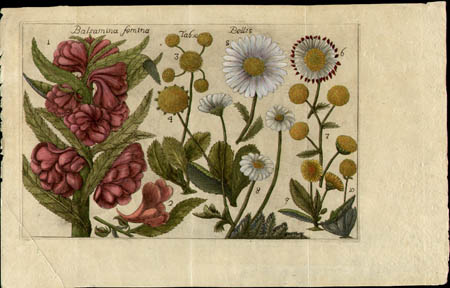
Above: The images are shown in the Inventory Viewer cropped the way they would typically be matted, but each sheet has wide margins like the example above. Full sheet views sent on request. Below: Details from two of the prints. |
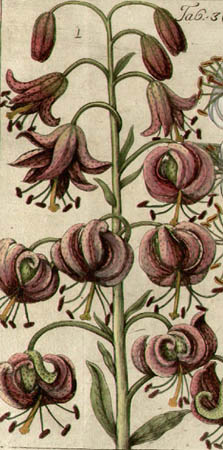 |
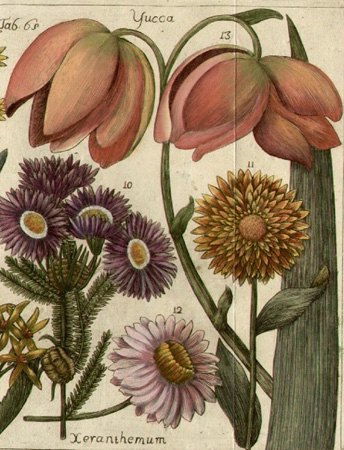 |
Lively and highly decorative botanical prints, with rich hand-coloring, all in a horizontal format. The compositions overall have an informal quality, filling the page with portrayals of various garden plants and details. Their artistic treatment is, at times, sculptural, emphasizing the rounded forms of the flowers. These prints, together with accompany text, were intended to serve as scientific studies for botanists and guides for gardeners and horticulturists. They also were intended as inspiration for painters and sculptors, and for decorative arts designers in creating patterns for china, fabrics, wall paper, etc. Flowers include balsma, daisies, marigolds, pelargonium, lilies, buttercups (ranunculus), angel's trumpet, violets, and exotic species such as yucca.
Filippo Arena was a Jesuit professor of mathematics and philosophy in Palermo. He was interested in the phenomenon of pollination of flowers by insects, which he explored in his work La Natura e Coltura dei Fiori Fisicamente Esposta, published under the name of his nephew, Abbot Ignazio Arena. The work was composed of three volumes: the first on botany and the anatomy and fertilization of flowers, the other two on horticulture, including 60 pages devoted to an in-depth discourse on the creation of a flower garden. The volumes contain a catalog of “noble” species with detailed descriptions of every flower represented in the 65 plates of La Natura. These images were composed by Arena in collaboration with his colleague, painter Mario Cammerari. Many of the renditions of individual flowers were derived from earlier publications, such as Johann Weinmann’s Phytanthoza Iconographia and G.B. Ferrari’s De Florum Cultura.
References:
Nissen, Claus. Die Botanische Buchillustration: ihre Geschichte und Bibliographie. Stuttgart:1951-66. 48.
Pritzel, Georg August. Thesaurus Literaturae Botanicae Omnium Gentium. Milan: 1950. 223.
Shejbal, J. “Gli Autori ed Artisti.” Amo Bulbi. http://www.amo-bulbi.it/gli_artisti.htm (16 March 2004).
Tomasi, Lucia Tongiorgi and Rachel Lambert Mellon. An Oak Spring Flora: Flower Illustration from the Fifteenth Century to the Present Time. New Haven: Yale University, 1997, p. 38.