Mark Catesby (1683-1749) (artist and etcher)
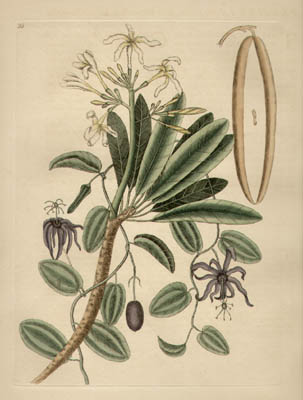
Plumeria flore niveo, foliis brevioribus obtusis and Grandilla, foliis Sarsaparillae trinerviis; flore purpureo; fructu Olivaeformi caeruleo
[White Frangipani and Passion Flower, Vol. II, Pl. 93]
from The Natural History of Carolina, Florida, and the Bahama Islands
Benjamin White, London: 1771 (third edition)
Hand colored engraving on wove paper
13.75 x 10 inches, plate mark
21.75 x 14.5 inches, overall
Sold, please inquire as to the availability of similar items.

Bahama Islands Flowering Plants
Mark Catesby, 18th C.
Mark Catesby, 18th C.
This item is sold. It has been placed here in our online archives as a service for researchers and collectors.
- Please inquire as to the availability of similar items currently in stock, or use the navigation bar above to browse our site for currently available items.
- Find guidelines for the use of images from georgeglazer.com.
- To see more archived items, view our directory.
- Find information about selling your art and antiques.
To see other Catesby prints on our site, use our site search engine.
Natural history print of plants native to the Bahama Islands: the branch of a white frangipani entwined with a sprig of purple passion flower. The white frangipani is a small tree with white tubular flowers and leathery, green leaves, known today by its scientific name Plumeria alba. Catesby shows the various stages of flowering of both plants from bud to flower to fruit. The white frangipani fruit eventually develops into paired cigar-shaped pods, which Catesby depicts in the upper right. The print is from a 1771 century reissue of Mark Catesby’s The Natural History of Carolina, Florida and the Bahama Islands (1729-1747).
Catesby wrote the following description of this print:
Plumeria flore niveo, foliis brevioribus obtusis.
This Shrub grows usually to the Height of ten Feet. Its Leaves are long, in Form, like those of the Oleander, but somewhat blunter at their Ends; they grow in Bunches, at the Ends of the Branches, from which also rises a succulent shining green Stalk, five Inches long, on the Top of which grow the Flowers, in a Cluster, which are mostly white, monopetalous, and tubulous, divided at the Top, into five deep Sections, the Inside of which is yellow, as is the Outside of the Tube, tho' not so bright.
The Seed-vessel is a double Pod, seven Inches long, curved at the Insides, and both Ends meeting: At their Time of Maturity the curved Side of each Pod splits open, and displays the Seeds, which are disposed in like Manner as the Scales of Fish.
Grandilla, foliis Sarsaparillae trinerviis; flore purpureo; fructu Olivaeformi caeruleo.
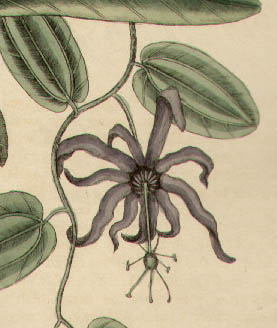
The Leaves of this Kind of Passion-Flower, are of an oblong oval Form, having three parallel Ribs, extending from the Stalk to the End, with smaller Veins, running obliquely to their Edges: The Flower is made up of ten narrow purple Petals, five of which are long, the other five about half as long: The Pointal arising from the Center of the Flower, is longer than in any other of this Tribe, that I have observed, The Embrio at the End of it, swells to a Fruit, of the Size and Form of an Olive: These Plants, as likewise the Plant on which this is supported, grow plentifully on many of the Bahama Islands, where I painted them in the natural Appearance as is here represenented.
Catesby’s important work was the first comprehensive publication on the natural history of the New World, and it influenced both Audubon and Linnaeus among others. The original work contained 220 fine hand-colored, folio size plates after his natural history paintings, many of which he etched himself, together with descriptions in English and French. Almost half the pictures depicted birds, the rest portrayed various animals and plants. In 1754, George Edwards (1694-1773) revised and reissued both volumes and in 1771 the publisher Benjamin White reissued Edward's edition, adding Linnaean names to all Catesby's plants and animals.
Mark Catesby, a British scientist and illustrator, trained as a botanist. Beginning in 1712, he spent seven years in Virginia, amassing collections of plant and animal specimens which he shipped back to wealthy patrons in England. With their encouragement, he undertook his Natural History, returning to North America for an extended stay in 1722 as well as learning etching so he could control the quality of the final product. His depictions of birds, which comprise 109 of the 220 illustrations, contributed to the development of ornithological illustration due to several innovative qualities: their naturalism, the use of foliage backgrounds and the folio format. For decades Catesby’s books remained the definitive source for information about New World birds, consulted by the likes of Linnaeus, Thomas Jefferson and Lewis and Clark.
References:
“Reception.” Mark Catesby’s Natural History. http://xroads.virginia.edu/~ma02/amacker/etext/pre_4.htm (16 August 2004).
“Plumeria Flore Niveo...” Mark Catesby’s Natural History. http://xroads.virginia.edu/~ma02/amacker/etext/II_93.htm (16 August 2004).
Stewart, Doug. “Abstract of an Article on Mark Catesby” Smithsonian Magazine. September 1997. http://www.smithsonianmag.si.edu/smithsonian/issues97/sep97/catesby.html (25 June 2004).
The Library of H. Bradley Martin: Magnificent Color-Plate Ornithology. New York: Sotheby’s, 1989. pl. 65.