H. L. Duhamel du Monceau (1700-1782) (author)
Pierre-Joseph Redouté (1759-1840) (after)
J. Lemaire (engraver)
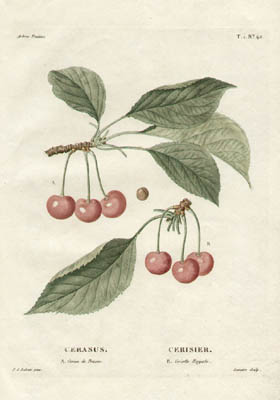
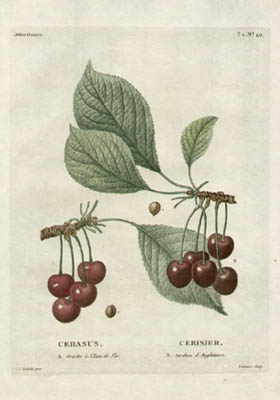
Cerasus/ Cerisier [Cherries]
from Nouveau Traité des Arbres Fruitiers [New Treatise on Fruit Trees]
Paris: Early 19th Century
Color printed stipple engravings
12 x 9 inches, plate mark
16.5 x 10 inches, overall
Sold, please inquire as to the availability of similar items.

Stipple Engraved Cherries
After P. J. Redouté
After P. J. Redouté
This item is sold. It has been placed here in our online archives as a service for researchers and collectors.
- Please inquire as to the availability of similar items currently in stock, or use the navigation bar above to browse our site for currently available items.
- Find guidelines for the use of images from georgeglazer.com.
- To see more archived items, view our directory.
- Find information about selling your art and antiques.
 |
 |
 |
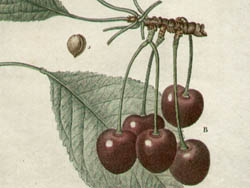 |
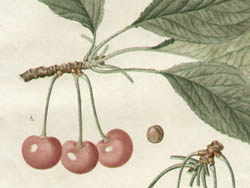
Pair of natural history studies of cherries depicting tree cuttings bearing leaves and fruit, and with details of their pits, by the great French botanical artist Pierre-Joseph Redouté. Rendered in a scientific illustrational style, they were originally created for the monumental seven-volume fruit-tree horticultural study produced by the French botanist Henri Louis Duhamel Du Monceau during the golden age of French botanical illustration, Traité des Arbres et Arbustes que l’on Cultive en France en Pleine Terre [Treatise on the Trees and Shrubs Cultivated Outdoors in France] (1801-19). The offered pair of cherry prints is from a later compilation of just the fruit prints from this work.
Stipple engraving, a sophisticated printing technique, was employed to achieve the luminosity, sheen and dimensionality of Redoute’s original watercolors of the fruits and foliage. Many of the artists and engravers for the original series of almost 500 images were also associated with other great botanical books illustrated by Redouté. The production of such a richly colored plate involved a team of over 20 engravers.
Duhamel du Monceau was one of outstanding botanists and horticulturists of the 18th century, and among the most important French writers on fruit, plant physiology and agriculture. He produced several horticultural colorplate sets focusing on fruits, the most famous of which is Traité des Arbres Fruitiers [Treatise on Fruit Trees] Nouvelle Edition, Paris: 1807-1835, illustrated by P.J.F. Turpin and A. Poiteau. This work is "one of the finest and rarest books on fruit, with many beautiful plates" according to botanical expert Dunthorne. Botanical historian F.A. Stafleu calls this a virtually independent work by Poiteau and Turpin, though conceived of as an act of homage to Duhamel du Monceau and his Traité of 1768. As the author-artists declare in their joint preface, "il nous a été facile d ameliorer le champ que le savant Duhamel a si habilement défriché." ["It was easy for us to improve the field that the scholar Duhamel so skillfully cleared," i.e. they built upon his pioneering work.]
Pierre-Joseph Redouté is the greatest botanical artist of the golden era of botanical illustration. His greatest works are Les Roses, Les Liliacées, and Choix Des Plus Belles Fleurs. Redouté recorded many of the beautiful ornamental garden flowers of Napoleon's wife, the Empress Josephine, as artist-in-residence at the Malmaison gardens.
Reference:
Dunthorne, Gordon. Flower and Fruit Prints of the 18th and Early 19th Centuries. Their History, Makers and Uses, with a Catalogue Raisonne of the Works in Which They are Found. Washington, D.C.: Published by the Author, 1938. 243, 244.