Joris Hoefnagel (1542-1601)
Aeternum Florida Virtus, Plate 2 [Eternally Blooming Virtue]
from Archetypa studiaque patrisä, Part II
Frankfurt: 1592
Hand-colored engraving
6 x 8.5 inches, overall
5.75 x 8.25 inches, platemark
Sold, please inquire as to the availability of similar items.

Hoefnagel Botanical and Insect Study
Late Renaissance Natural History Engraving
Late Renaissance Natural History Engraving
This item is sold. It has been placed here in our online archives as a service for researchers and collectors.
- Please inquire as to the availability of similar items currently in stock, or use the navigation bar above to browse our site for currently available items.
- Find guidelines for the use of images from georgeglazer.com.
- To see more archived items, view our directory.
- Find information about selling your art and antiques.

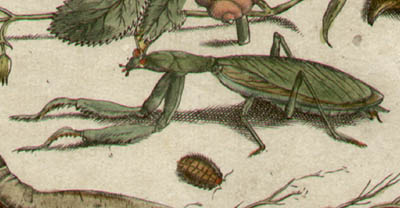
A rare Late Renaissance natural history study of flowers and insects, arranged in a lively composition that conveys delight in the varied forms of nature. In the center, a large snail wraps itself around the stem of a rose; bending toward it are a daffodil on the left and another flower on the right. In the foreground a caterpillar raises itself at one end of a root that seems to mimic the posture of a nearby praying mantis. The artist has also included a pod, another flower and various flying and crawling insects. The plate originally was published in a four-part work published in one volume in 1592. An uncolored example of this print is in the collection of Fine Arts Museums of San Francisco and may be viewed online (see references below).
The title in Latin inscribed at the top translates as Eternally Blooming Virtue. In the lower portion of the print appears the phrase “Mirabae celerem fugitina aetate rapinam et dum nascuntur consenuisse Rosas” which roughly translates as a poetic statement that however quickly life flees plunder, “the rose while being born grows old.” The presence of the snail wrapped around the rose, the caterpillars and other insects that eat plants are a poignant reminder of the impermanent nature of existence, even as it continues its eternal cycle of renewal and decay. This theme in still lifes, known as “vanitas,” became very popular in Netherlandish painting of the 17th century.
Joris (sometimes referred to as Georg) Hoefnagel, is considered the last of the great Flemish manuscript illuminators as well as a leading topographical draftsman of his time. He was a pivotal figure in the transition from the treatment of floral motifs in manuscript illumination and ornamental design to the emerging genre of floral still lifes in European art at the end of the 16th century. Born in Antwerp, he was the son of a wealthy diamond merchant. His first major project was a suite of engravings from topographical drawings he made on a trip through England, France, and Spain which became the models for a six-volume atlas. After completing his art studies under Jan Bol, he turned to the painting of animals, plants and insects while also working as a dealer in jewels. When Antwerp was plundered by the Spaniards, Hoefnagel and cartographer Abraham Ortelius fled to Bavaria, where he became a court artist for Albert V, Duke of Bavaria and completed a multi-volume set of natural history miniatures. In 1591, he was appointed court artist for the Holy Roman Emperor Rudolf II, who was known for his cabinet of curiosities, or natural history collection. There he embellished Mira calligraphiae monumenta, a manuscript completed 30 years earlier by calligrapher Georg Bocskay, adding illustrations of fruit, plants, animals and insects. This magnificent work is now in the collection of the Getty Museum in Los Angeles. Hoefnagel spent his final years in Vienna.
References:
“Image Base Search Results: Joris Hoefnagel.” Fine Arts Museums of San Francisco. 2003. http://search.famsf.org:8080/view.shtml?record=313346&=list&=1&=&=And (13 October 2004).
“Joris (Georg) Hoefnagel.” The Grove Dictionary of Art. New York: Macmillan. 2000. Artnet.com. http://www.artnet.com/library/03/0384/T038428.asp (13 October 2004).
“Joris Hoefnagel.” J. Paul Getty Trust. 2004. http://www.getty.edu/art/collections/bio/a992-1.html (13 October 2004).
Williamson, George C., ed. Bryan's Dictionary of Painters and Engravers. London: G. Bell and Sons: 1930. Vol. 3, pp. 51-52.