Frederik Ottens (after)
J. Oosterwyk (engraver)
Frontispiece
from De Europische Insecten and
Over de Voortteeling en wonderbaerlyke Veranderingen der Surinaamsche Insecten
J.F. Bernard, Amsterdam: 1730
Hand-colored engraving
20.5 x 14.25 inches, overall
18 x 12.5 inches, plate mark
Sold, please inquire as to the availability of similar items.

Merian Frontispiece
Butterflies of Surinam
Butterflies of Surinam
This item is sold. It has been placed here in our online archives as a service for researchers and collectors.
- Please inquire as to the availability of similar items currently in stock, or use the navigation bar above to browse our site for currently available items.
- Find guidelines for the use of images from georgeglazer.com.
- To see more archived items, view our directory.
- Find information about selling your art and antiques.
 |
 |
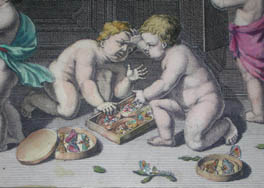 |
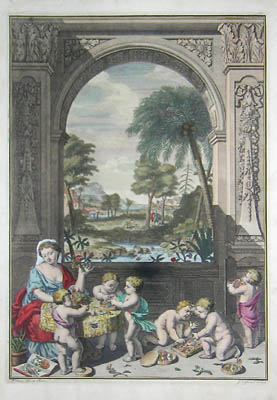
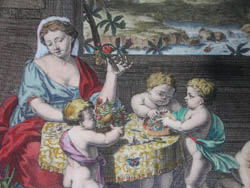
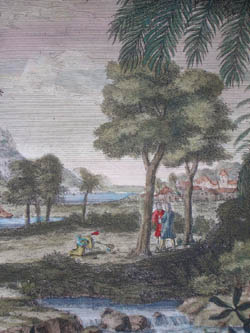
This frontispiece illustration from Maria Sybilla Merian’s famous study of the butterflies of Surinam depicts an allegorical scene with the artist seated at a table before a monumental Baroque stone arch, assisted in her work by a group of cherubs collecting and mounting butterflies, some cooperating and some competing. Through the arch appears a view of the tropical landscape of the Central American habitat, a man wandering through it with a butterfly net. This plate was probably originally published in a posthumous collection of Merian’s works produced by J.F. Bernard, the first to bring together all her major works on European and Surinam insects. Ten years after her death, Bernard acquired all the original copper plates, including her early botanical works published in Nuremburg, and published them in a two-volume set with a frontispiece by Frederik Ottens (as offered here).
Maria Sybilla Merian (1647-1717), born in Germany, was a descendant of a family of botanical artists. Her father, Matthaeus Merian, a botanical artist, died when she was an infant; her stepfather was Dutch flower painter Jacob Marrell, who encouraged her vocation. She was also one of the finest botanical artists of her period, in the tradition of the great flower painters of 17th-century Holland, but was mainly interested in entomology, and from a young age studied and drew the developmental stages of insects. Married at 18 to a pupil of Marrell’s, she initially lived with him in Nuremberg. In 1679, 1683 and 1717 she published three volumes on European insects, portraying the insects in various stages of development with the plants on which they lived, the first artist to do so. She left her husband in 1685 and took her daughters and mother to live with a religious sect called the Labadists in Castle Waltha in the Netherlands, owned by the governor of Surinam. Inspired by his collection of insects, she traveled to Surinam in 1699 with her daughters to pursue her own study until illness forced her to return to Holland two years later. The result of two years of collecting and painting was published as Metamorphosis Insectorum Surinamensium in 1705. A second edition was published later, augmented by drawings and specimens produced by her eldest daughter. These “folio plates brought to the eyes of Europeans surprising and vivid pictures of tropical plants...” (Blunt) and were appreciated then, as now, for their outstanding artistic qualities as well as scientific importance. Her original paintings of Surinam insects are in the British Museum and the Royal Library at Windsor. Merian died in Amsterdam.
Frederik Ottens was a designer and engraver of portraits, religious subjects, city views and decorative subjects in 18th-century Amsterdam. He is known to have worked in Delft in 1727.
References:
Bénézit, E. Dictionnaire critique et documentaire des Peintres, Sculpteurs, Dessinateurs et Graveurs. France: Librairie Gründ, 1966. Vol. 6, p. 459 (Ottens).
Blunt, Wilfred, rev. by Stearn, William T. The Art of Botanical Illustration. Woodbridge, Suffolk, England: Antique Collectors Club, 1994. pp. 102, 142-146.
“Highlights and Recent Fairlist 2003.” Acanthus Antiquarian Booksellers. 2003. http://www.acanthus.nl/highlights.html (14 October 2004).
Nissen BBI, 1341 & 1342.
Nissen ZBI, 1642