Christopher Jacob Trew (1695-1769) (editor)
George Dionysius Ehret (1710-1770) (after)
Johann Jakob Haid (1704-1767) or
J.E. Haid (engravers and colorists)
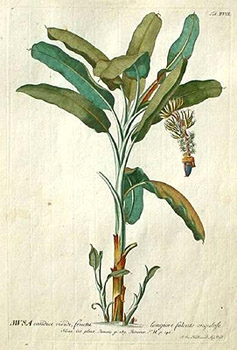
Musa caudice viridi, fructu longiore falcato anguloso
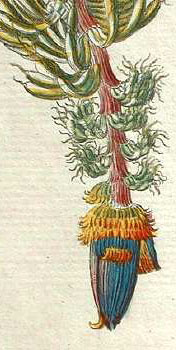
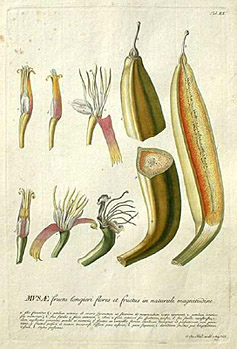
Musae fructu longiori flores et fructus in naturali magnitudine
from Plantae Selectae [Selected Plants]
J.J. & J.E. Haid, Augsburg: 1750-1773
Hand-colored engravings
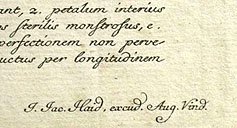
Engraved name lower right: J. Jac. Haid, excud, Aug. Vind.
Initial word in title gilt lettered
16.5 x 11.5 inches, approximate plate size
20.5 x 14.25 inches, overall
Sold, please inquire as to the availability of similar items.

Banana Botanicals
After George Dionysius Ehret
After George Dionysius Ehret
This item is sold. It has been placed here in our online archives as a service for researchers and collectors.
- Please inquire as to the availability of similar items currently in stock, or use the navigation bar above to browse our site for currently available items.
- Find guidelines for the use of images from georgeglazer.com.
- To see more archived items, view our directory.
- Find information about selling your art and antiques.
 |
 |
 |
 |
 |
 |
 |
 |
 |
 |
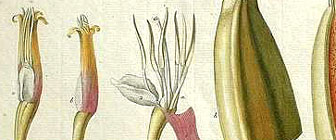 |
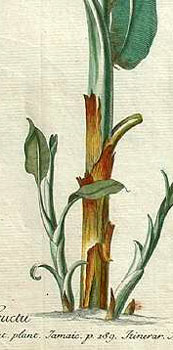
Pair of prints: a Jamaican banana tree and a study of banana fruit and flowers, based on the original studies by George Dionysius Ehret, considered one of the greatest of 18th-century botanical artists. The bananas and flowers are shown at actual size.
Christoph Jacob Trew, a physician and botanist, was Ehret's primary patron publishing both Plantae Selectae, one of the finest ever 18th-century botanical sets in which these prints were issued, and Hortus Nitidissimis, also with fine botanical plates. Trew had for a number of years been an admirer of Ehret's work. While Ehret was working as an artist for a banker in Regensburg, Germany, he met Trew, and the two remained friends and associates for life. Ehret's work was so accomplished, that the famous botanist Linnaeus wrote to Trew that "The miracles of our century in the natural sciences are your work of Ehret's plants. [N]othing to equal them was seen in the past or will be in the future."
Georg Dionysus (G.D.) Ehret was the dominant influence in botanical art during the 18th century. Ehret was born in Heidelberg, Germany, and trained as a gardener. He became the protégé of the Margrave of Baden-Durlach, who hired him to design town and palace gardens at Karlsruhe and make paintings of his flowers. After leaving the Margrave’s employ, relocated in Regensburg, where he met Johann Wilhelm Weinmann, and was engaged to produced drawings which were to be his first published works, for Phythanoza Iconographia. Upon producing the first 500 drawings, he had a dispute with Weinmann over compensation and obtained a new position copying plates for another patron, while also working independently on new paintings. His talents were recognized by Dr. Jakob Trew of Nuremberg, who became his lifelong patron and friend. With Trew’s backing, Ehret was able to leave his copying job. He traveled through Europe, including to Leiden in 1736, where he met the eminent naturalist Linnaeus, and then settled in England, where he remained the rest of his life. In London, he had a busy and successful career as a painter and instructor, obtaining numerous commissions from aristocratic patrons and having several duchesses and countesses among his pupils. Over his career, Ehret produced an important body of botanical paintings, including plates for a number of florilegia and travel books, notably Trew’s Plantae Selectae (1750-1773) and Hortus…Amoenissimorum Florum (1750-1786), and his own Plantae Paliliones Rariores (1748-1759) and Natural History of Barbados (1750). He often engraved his own plates. In 1757, he was made a Fellow of the Royal Society. His works today are represented in many important museum collections including the Victoria and Albert Museum and the British Natural History Museum.
References:
Blunt, Wilfred, rev. by Stearn, William T. The Art of Botanical Illustration. Woodbridge, Suffolk, England: Antique Collectors Club, 1994. Chapters 11-12.
Calman, Gerta. Georg Ehret, Flower Painter Extraordinary. 1977. p.97.
Coats No. 33.
Dunthorne, Gordon. Flower and Fruit Prints of the 18th and Early 19th Centuries. Their History, Makers and Uses, with a Catalogue Raisonne of the Works in Which They are Found. Washington, D.C.: Published by the Author, 1938. p. 309.
Hunt 539.
Nissen, Claus. Die Botanische Buchillustration: ihre Geschichte und Bibliographie. Stuttgart:1951-66. 1997.
Sitwell, Sacheverell. Great Flower Books, 1700-1900. New York: The Atlantic Monthly Press, 1990. p.144.
Pritzel, Georg August. Thesaurus Literaturae Botanicae Omnium Gentium. Milan: 1950. 9499.
Stafleu, Frans A. and Richard S.Cowan. Taxonomic Literature. Utrecht: 1967. 2nd ed., Utrecht: 1976-1988 TL2 15.131.