Amos Doolittle (1754-1832) (artist and engraver)
Elihu Phinney (d. 1813) (paper maker)
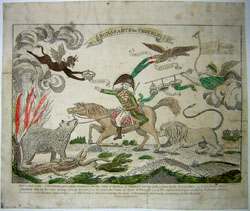
Bonaparte in Trouble
Shelton & Kensett, Cheshire, Connecticut: c. 1814
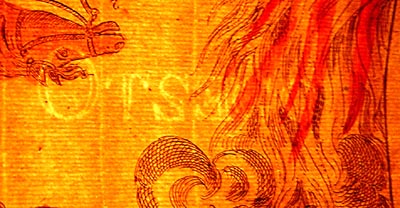
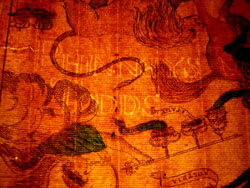
Hand colored-engraving on laid paper, watermarked “Phinneys Todds Otsego”
12.75 x 15 inches, overall
9.75 x 14 inches, printed border
Sold, please inquire as to the availability of similar items.

Napoleon in Trouble
Satirical Engraving by Amos Doolittle, 1814
Satirical Engraving by Amos Doolittle, 1814
This item is sold. It has been placed here in our online archives as a service for researchers and collectors.
- Please inquire as to the availability of similar items currently in stock, or use the navigation bar above to browse our site for currently available items.
- Find guidelines for the use of images from georgeglazer.com.
- To see more archived items, view our directory.
- Find information about selling your art and antiques.
 |
 |
 |
 |
 |
 |
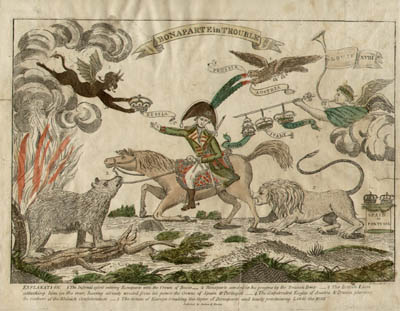
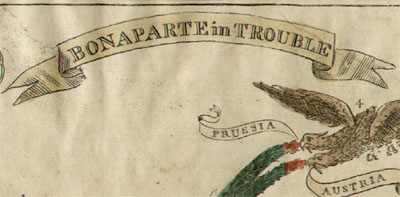
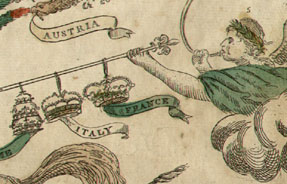
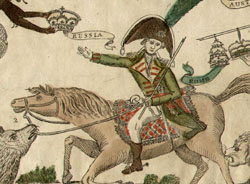
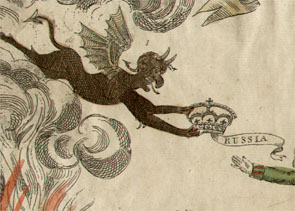
Political satire print on the defeat of Napoleon in 1814. Beneath a floating banner announcing “Bonaparte in Trouble,” the erstwhile emperor of France sits upon a stumbling horse, hemmed in on all sides by allegorical animals representing the major powers of Europe, as well as the Devil luring him to his downfall with visions of expanding his empire into Russia. These figures are numbered and interpreted in an “Explanation” at the bottom: “1 The Infernal spirit enticing Bonaparte with the Crown of Rusia [sic]. 2. Bonaparte arrested in his progress by the Russian Bear. 3. The British Lion attacking him in the rear, having already wrested from his power the Crowns of Spain & Portugal. 4. The Confederated Eagles of Austria & Prussia, plucking the feathers of the Rhiniste Confederation. 5. The Genius of Europe breaking the scepter of Bonaparte and loudly proclaiming Louis the XVIII.”
This print is in the collections of the Boston Public Library and the Winterthur Museum. It is a scarce and significant example of early American political satire printmaking, a highly popular genre from the mid 18th through mid 19th centuries.
Amos Doolittle was one of the earliest American copperplate engravers. He spent his life in and around New Haven, Connecticut. Initially apprenticed to a jeweler and silversmith, he taught himself engraving and became a prolific producer of historical and satirical engravings, bookplates, portraits and biblical illustrations. His first major project was a famous series of four engravings after Ralph Earle, portraying the Battles of Lexington and Concord. These were among the very earliest historical prints done in America, preceded by only two others. Doolittle had himself been present at these events as a Connecticut militia-man, and the prints are noteworthy for the lack of romanticization found in later prints of the subject. He freely expressed his patriotism in his satires, however, stating that such prints "will have a tendency to inspire our countrymen with confidence in themselves, and eradicate any terrors that they feel as respects the enemy they have to combat." Doolittle trained at least one of his sons as an engraver, as well as James Wilson (1763-1855), who went on to become the first globe maker in America. The papers of Doolittle and his family are in the archives of Yale University, which also owns a number of his engravings.
Shelton & Kensett was an engraving and print publishing firm in Cheshire, Connecticut. It was co-founded by Thomas Kensett (1786-1829), an engraver who emigrated to the U.S. in 1812 from England, where he had previously been an engraver at Hampton Court.
This print is on paper watermarked “Phinneys Todd Otsego.” Elihu Phinney (d. 1813) was the first printer in Cooperstown, Otsego County, New York, and set up a printing and newspaper publishing business in 1795 that made Cooperstown a major publishing center for the next 50 years. His sons, Henry and Elihu Jr., took over the business upon his death in 1813. They became well-known for their ubiquitous bibles, publishing 138 editions between 1822 and 1848, after which the firm moved to Buffalo.
References:
Butterfield, Lyman H. “Cooper’s Inheritance: The Otsego Country and Its Founders.” New York History, Vol. 35, No. 4 (October, 1954), pp. 374-411. James Fenimore Cooper Society Web Site. http://external.oneonta.edu/cooper/articles/nyhistory/1954nyhistory-butterfield.html (8 April 8, 2004). (Phinney)
Fielding, Mantle. Dictionary of American Painters, Sculptors and Engravers. Green Farms, Connecticut: Modern Books and Crafts, 1926, rev. ed. 1974. pp. 197-198. (Kensett)
Groce, George C. and Wallace, David H. The New-York Historical Society’s Dictionary of Artists in America 1564-1860. New Haven: Yale University Press, 1969. pp. 183-184. (Doolittle)
Stauffer, David McNeely. American Engravers on Copper and Steel. New York: Burt Franklin: 1907. Vol. 1, p. 66-67, & Vol. II, p. 92, no. 530. (Doolittle)
Shadwell, Wendy. American Printmaking:The First 150 Years. New York: The Museum of Graphic Art, 1969. p. 50; pl. 97. (Doolittle) (similar print illustrated, collection of Mr. and Mrs. J. William Middendorf II)
“’The Body Politic’ traces the evolution of satiric images.” Yale Bulletin and Calendar. September 22, 2000. Vol. 29, No. 3. http://www.yale.edu/opa/v29.n3/story19.html (8 April 2004). (Doolittle)