John George Wood (d. 1838) (after)
William Green (1760-1823) (engraver)
Edward Hasted (1732-1812) (editor)
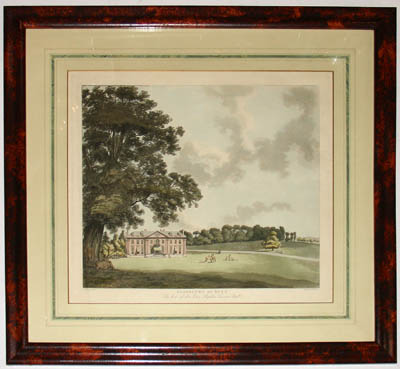
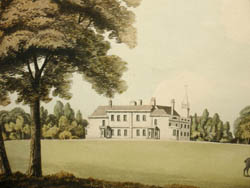
Bradbourn in Kent. The Seat of John Papillon Twisden Bar.
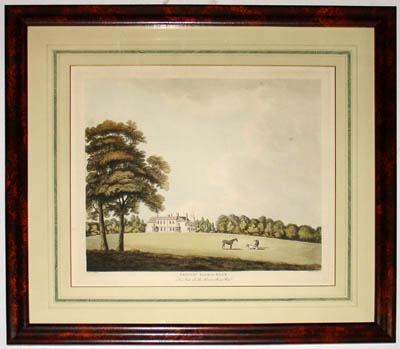
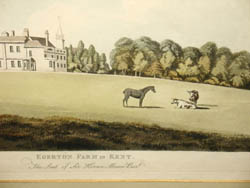
Egerton Farm in Kent. The Seat of Sir Horace Mann Bar.
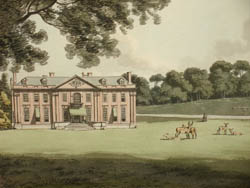
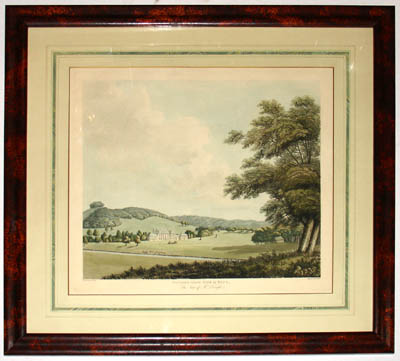
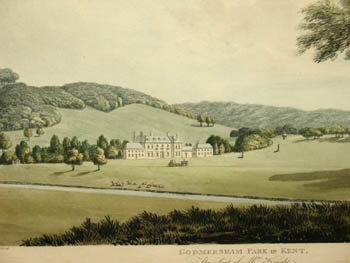
Godmersham Park in Kent. The Seat of Mrs. Knight.
from
The History and Topographical Survey of the County of Kent
Canterbury: 1778-1799
Color-printed aquatints
14.5 x 15.5 inches, image
15.5 x 17.75 inches, mat opening
24.5 x 26.5 inches, frame
Sold, please inquire as to the availability of similar items.
See also: Fredville in Kent from this series.
Views of three manors from Edward Hasted’s major work, an 18th century history of the county of Kent, England, which included 40 engravings of houses. The estates pictured here are associated with interesting historical anecdotes. Godmersham Park is associated with the author Jane Austen, whose brother inherited it after he was adopted by the Knight family; there is speculation that she wrote parts of Pride and Prejudice there. John Papillon Twisden inherited the estate of Bradbourn (also spelled Bradbourne) and the title of 7th Baronet (abbreviated “Bar.” in the print’s title) under controversial circumstances. Sir Horace Mann hosted the composer Mozart and his family in 1765 at Egerton Farm. Mann’s famous uncle, also named Sir Horace Mann, served as British Envoy to the Court of Tuscany. The prints shown here are in wooden frames.
Hasted’s 12-volume History and Topographical Survey of the County of Kent was a comprehensive account of the region from ancient to present times, and as the title page states, was “illustrated with maps, views of antiquities, seats of the nobility and gentry, &c.” These included a large folding county map, 35 other maps, 40 engravings of houses and 23 other plates. The British Library has the Godmersham Park view in its collection and identifies it as coming from Volume XI, Illustrations of Kent (see References below).
John George Wood was a British engraver and publisher based in London. Primarily a watercolorist, he exhibited at the Royal Academy from 1793 to 1811 and also published works on perspective.
William Green was a British painter and engraver who began his career as a surveyor in Manchester. He studied with the prominent painter Landseer and went on to produce mainly aquatints, usually of his own watercolors and drawings. A friend of the poets Wordsworth and Coleridge, he published a series of views of the Lake District and North of England between 1794 and1822. Green also exhibited at the Royal Academy.
References:
Hatton, Ronald G. and Hatton, Christopher H. “Notes on the Family of Twysden and Twisden.” Archaeologia Cantiana . Vol. 58. 1945. p. 61 online at Kent Archaeological Society. 15th February 2005. http://www.kentarchaeology.org.uk/Research/Pub/ArchCant/Vol.058%20-%201945/07/61.htm (20 June 2005).
“Local History Collection.” University of Kent at Canterbury Special Collections. http://library.kent.ac.uk/library/special/html/specoll/local2.htmn (20 June 2005).
Maxted, Ian. "The London book trades 1775-1800: a preliminary checklist of members." Exeter Working Papers in British Book Trade History. U.K.: Devon Library and Information Services. 20 June 2001. http://www.devon.gov.uk/library/locstudy/bookhist/long.html and http://www.devon.gov.uk/library/locstudy/bookhist/lonw.html (16 December 2002).
Moody, Ellen. “Longleat, Godmersham, and Wye.” Ellen Moody. 4 January 2003. http://www.jimandellen.org/finch/emion4-2.htm (20 June 2005).
“Mozart’s Stay in Canterbury.” Mozart Ways. 2005. http://www.mozartways.com/content.php?m=2&typ2=79&lang=en (20 June 2005).
“View of Godmersham Park.” British Library Images Online. http://www.imagesonline.bl.uk/britishlibrary/controller/subjectidsearch?id=11076&&idx=1&startid=11388 (20 June 2005).