Edwin Willard Deming (1860-1942) (American)
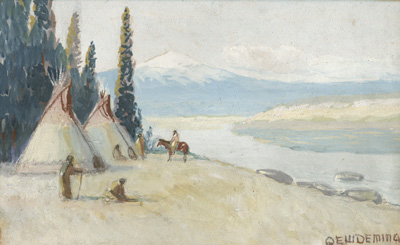
Indian Encampment
American: 1st Quarter 20th Century
Pencil and gouache on paper
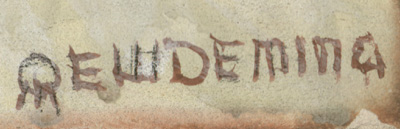
Signed lower right: "EW Deming" with artist's cypher
7.5 x 12.25 inches on card
10.75 x 15.25 overall tipped to paper mount
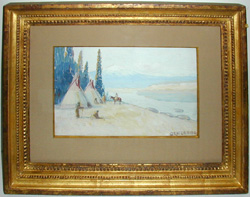
15.25 x 20 inches custom gold-leaf frame, linen mat with gold fillet
Provenance: Graham Gallery , New York City (their label verso)
Sold, please inquire as to the availability of similar items.

Indian Encampment
Painting by Edwin Willard Deming
Painting by Edwin Willard Deming
This item is sold. It has been placed here in our online archives as a service for researchers and collectors.
- Please inquire as to the availability of similar items currently in stock, or use the navigation bar above to browse our site for currently available items.
- Find guidelines for the use of images from georgeglazer.com.
- To see more archived items, view our directory.
- Find information about selling your art and antiques.
 |
 |
 |
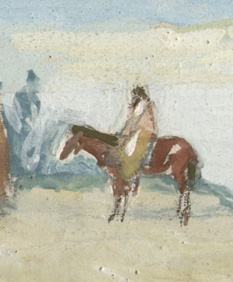 |
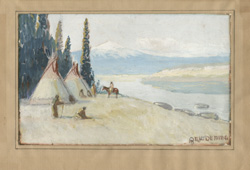
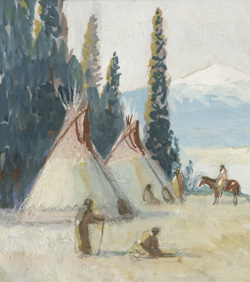
Serene landscape showing a small encampment of two tepees and five Indians, one on horseback. The tepees face a river or lake, with a snow-capped mountain in the distance. The forms are rendered in pale colors with blurred edges suggestive of early-morning haze.
Edwin Willard Deming was an artist said to know more about the American Indian than any other painter of his day. Born in Ohio , he spent much of his childhood in Western Illinois , growing up with Indian friends. In his teens he traveled west to Indian territories to sketch the inhabitants. Although his parents tried to steer him toward a law career, he was determined to become an artist, and studied at the Art Students League in New York and the Academie Julian in Paris . Returning to the U.S. , he supported himself painting cycloramas -- large, touring circular murals -- and made trips to the Southwest and to Oregon to paint Native Americans. He immersed himself in Indian culture, even living with them for a year. In 1916, he painted the murals of Indian life for the American Museum of Natural History , New York . He spent his latter years in New York City , where he was a member of the National Arts Club and National Society of Mural Painters. His work is in numerous museums including the Brooklyn Museum and National Gallery of Art, Washington, D.C.
Reference:
Zellman, Michael David, dir. American Art Analog. Vol. 2. Chelsea House: New York, 1986. p. 574.