James Basire (artist and engraver)
From an Antique Helmet of Bronze, of the same Size, found at Ribchester, in the Possession of Charles Townley Esq'r.
Society of Antiquaries of London, London: April 23, 1799
Black-and-white engraving
21.5 x 14.25 inches
Sold, please inquire as to the availability of similar items.

Roman Helmet Engraving
James Basire
James Basire
This item is sold. It has been placed here in our online archives as a service for researchers and collectors.
- Please inquire as to the availability of similar items currently in stock, or use the navigation bar above to browse our site for currently available items.
- Find guidelines for the use of images from georgeglazer.com.
- To see more archived items, view our directory.
- Find information about selling your art and antiques.
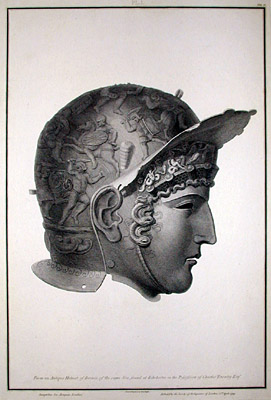
Study of a helmet discovered in 1796 by a boy playing on the site of a Roman fortress at Ribchester. It is believed to have been used by cavalrymen for parading and cavalry sports, which were displays of horsemanship and weapons drills. The crown of the helmet is elaborately decorated with battle scenes and classical figures in relief. Ribchester, a town in the outskirts of the northwestern sector of the Manchester metropolitan area, was settled by Romans after their invasion of England circa 55 B.C. The Romans named the settlement Bremetennacum, and built a large fort with granaries that covered approximately six acres. The original helmet is in the collection of the British Museum. A bronze reconstruction may be found at the Museum of Antiquities in Newcastle-upon-Tyne.
Four generations of Basires were engravers. Of those, three were named James and two of these could have engraved this print, because they both served as Engraver to the Society of Antiquaries. The elder James Basire (1730-1802) became known as an engraver of architecture and was employed on the first volume of James Stuart's and Nicholas Revett's classic book The Antiquities of Athens (1762). He traveled in Italy the following year, and around that time became Engraver to the Society of Antiquaries. He also became Engraver to the Royal Society in 1770. He produced many fine prints for the Antiquaries and other publications as well as separately-issued prints after paintings for publishers such as John Boydell. His print Champ d'or, 1520, executed for the Antiquaries, was exhibited in 1775 as "the largest plate engraved in England." He exhibited at the Society of Artists from 1761 to 1783. William Blake served as one of his apprentices from 1772 to 1779. Basire's eldest son, also named James Basire (1769-1822), succeeded his father as Engraver to the Antiquaries and to the Royal Society. He is known for his plates of English cathedrals after John Carter; and a set after the Bayeux Tapestry. He also engraved the annual Oxford Almanacks for several years.
References:
"Basire." The Grove Dictionary of Art. New York: Macmillan. 2000. Online at Artnet.com. http://www.artnet.com/library/00/0067/T006725.asp (4 February 2003).
British Museum. http://www.britishmuseum.org/ (4 February 2003).
Lassey, Steve. "Roman Ribchester." 24 April 2002. http://www.genealogy.org/~slassey/ribchest.htm (4 February 2003).