John Trumbull (1756-1843) (after)
William Sharp (1749-1824) (engraver)
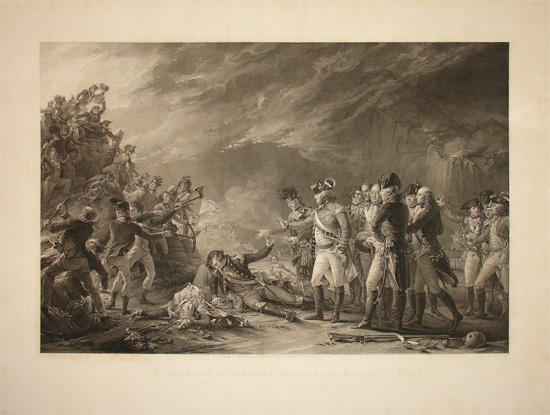
The Sortie Made by the Garrison of Gibraltar in the Morning of the 27 of November 1781
John Trumbull, William Sharp, and A.C. de Poggi, London: January 1, 1799
Engraving, uncolored
21.75 x 31.75 inches, platemark
27.25 x 35.75 inches, overall
Sold, please inquire as to the availability of similar items.

The Sortie Made by the Garrison of Gibraltar
Military History Engraving, London: 1799
Military History Engraving, London: 1799
This item is sold. It has been placed here in our online archives as a service for researchers and collectors.
- Please inquire as to the availability of similar items currently in stock, or use the navigation bar above to browse our site for currently available items.
- Find guidelines for the use of images from georgeglazer.com.
- To see more archived items, view our directory.
- Find information about selling your art and antiques.
 |
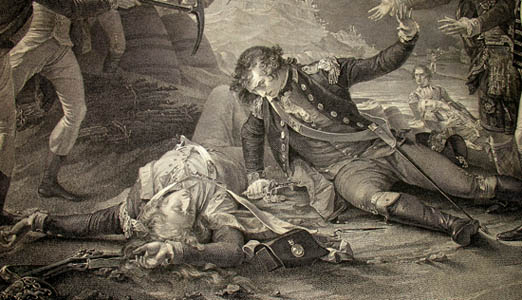 |
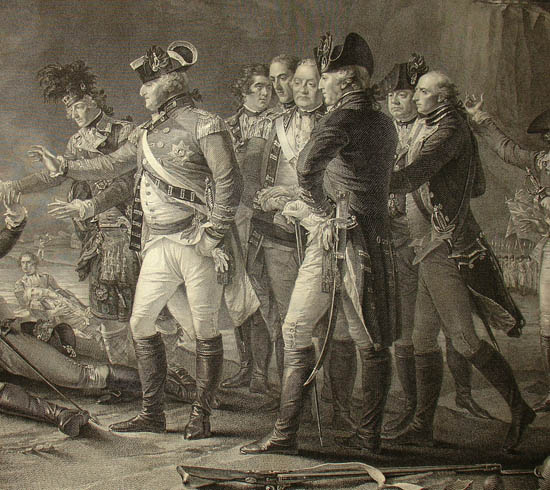
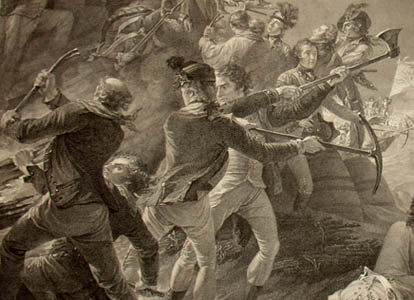
Engraving after a 1789 oil painting by John Trumbull of a dramatic and heroic moment in the aftermath of a military engagement at Gibraltar during the three-year siege of British fortifications there by French and Spanish forces. During the night of November 26th, 1781, the British responded with a highly successful surprise attack, or sortie. The Spanish soldiers fled, leaving behind the wounded officer Don Jose de Barboza. He is shown refusing offers of assistance from the British General George Elliott and Captain Mackenzie as he lies beside his broken sword. Trumbull made three versions of the subject, considered one of his major works. This print is based on the last and largest, at about six by nine feet, which is on display at the Metropolitan Museum of Art and can be viewed on their web site (see References below). The print is one of the largest engravings produced by the prominent British engraver William Sharp and he faithfully captures the expressive faces of the British officers that are a notable feature of the painting.
John Trumbull was an important American painter, architect and author, known for his history paintings of scenes from the American Revolution. The son of Jonathan Trumbull, Governor of Connecticut, he graduated from Harvard in 1773. During the Revolution he served as an officer between 1775 and 1777, rising to the rank of colonel. In 1784 he went to London to study painting with Benjamin West, and shortly thereafter began a series of history paintings and engravings in the 1780s and 1790s that are now considered important documents of the period. He spent 10 years in England from 1794 as an American commissioner under the Jay Treaty. In 1817, the U.S. Congress commissioned him to paint four large for the rotunda of the Capitol -- Washington Resigning His Commission, The Surrender of Cornwallis, The Surrender of Burgoyne and The Declaration of Independence -- which he completed in 1824. The first art gallery at an educational institution, the Trumbull Gallery at Yale University, was established in 1831 with the donation of his art collection and formed the basis of what became the Yale University Art Gallery.
William Sharp was a British draftsman and engraver known for his historical and religious subjects and portraits after the old masters and his contemporaries, such as Benjamin West, John Trumbull and Joshua Reynolds. He received his early training as an apprentice engraver of ornamental designs on firearms. He became an accomplished and successful engraver, producing illustrations for the Novelists Magazine and various books, and separately issued prints for printsellers such as John Boydell. Sharp began publishing his own prints in about 1787. In 1814, Sharp was elected a member of the Imperial Academy at Vienna and of the Royal Academy of Bavaria. He was offered an associate membership in the English Royal Academy but turned it down because engravers were not eligible to become full academicians. He also involved himself in controversial causes. As a young man, he was a republican and a friend of Thomas Paine and Horne Tooke. At one point he was examined for treason by the Privy Council. Later he became a staunch adherent of Joanna Southcott's prophetic religious ministry.
Full publication information: Painted by John Trumbull Esqr. Engraved by W. Sharp. London Published Jan'y 1, 1799, by J. Trumbull, W. Sharp, & A.C. de Poggi, No. 91, New Bond Street.
References:
Baker, W.S. William Sharp, Engraver, Descriptive Catalogue of His Works. Philadelphia: Gebbie & Barrie, 1875. Online at Archive.org: https://archive.org/stream/cu31924030670974#page/n5/mode/2up (20 December 2013).
"John Trumbull." Encyclopaedia Britannica. 20 May 2013. http://www.britannica.com/EBchecked/topic/607212/John-Trumbull (20 December 2013).
"John Trumbull Papers." Connecticut Historical Society. http://www.chs.org/finding_aides/finding_aids/trumj1843.html (20 December 2013).
Maxted, Ian. "The London book trades 1775-1800: a checklist of members." Exeter Working Papers in Book History. 3 March 2012. http://bookhistory.blogspot.com/2007/01/london-1775-1800-s.html (20 December 2013).
"The Sortie Made by the Garrison of Gibraltar." Metropolitan Museum of Art. 2000-2013. http://www.metmuseum.org/collections/search-the-collections/12828 (20 December 2013).