Joshua Reynolds (1723-1792) (after)
John Jones (engraver)
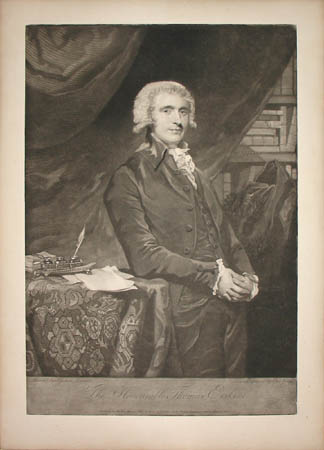
The Honourable Thomas Erskine
J. Jones, London: May 13, 1786
Mezzotint, 2nd state
19.75 x 13.75 inches, image
23 x 16.5 inches, overall
Provenance: M. Knoedler & Co., New York
Sold, please inquire as to the availability of similar items.

Thomas Erskine, British Free Speech Advocate
Portrait Engraving After Joshua Reynolds
Portrait Engraving After Joshua Reynolds
This item is sold. It has been placed here in our online archives as a service for researchers and collectors.
- Please inquire as to the availability of similar items currently in stock, or use the navigation bar above to browse our site for currently available items.
- Find guidelines for the use of images from georgeglazer.com.
- To see more archived items, view our directory.
- Find information about selling your art and antiques.
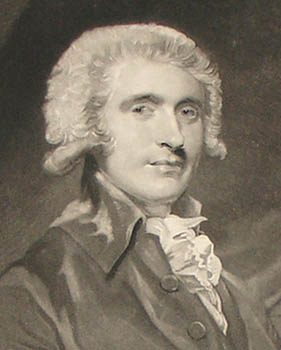 |
Portrait engraving after Sir Joshua Reynolds of Thomas Erskine, 1st Baron Erskine (1750-1823), Lord Chancellor of England. The three-quarter length portrait shows Erskine dressed leaning against a table upon which rest papers, inkwells and a quill pen. The engraving captures the fluid, painterly quality of Reynolds style.
Erskine was a lawyer and Whig politician, serving as Lord Chancellor under Prime Minister William W. Grenville from 1806 to 1807. He made his name as a defender of political radicals and forceful advocate for freedom of speech and of the press during the 1790s. Notable cases include an unsuccessful defense of Thomas Paine for a seditious libel charge after publication of the Rights of Man (1791) and securing not guilty verdicts for the three co-defendants in the Treason Trials (1794). Erskine also represented Queen Caroline regarding her divorce in 1820.
Sir Joshua Reynolds was the foremost portrait painter in England in the 18th century, and was extremely influential on later generations of artists. His poses were intended to invoke classical values and to enhance the dignity of his sitters. His style incorporated strong lighting, rich color and bravura paint handling. In addition to his portraits, he was known for history painting and genre scenes, called "fancy pictures" at the time. As first president of the Royal Academy in London, he significantly raised the profile of art and artists in Britain. Reynolds is also known for his eloquent Discourses on Art, delivered to the students and members of the Academy between 1769 and 1790.
John Jones was a London-based engraver and printseller active from 1775. He was a mezzotint and stipple engraver mainly of portraits by Reynolds, Romney and others, and published most of his plates himself. He exhibited at the Society of Artists from 1780-91 and served as Engraver Extraordinary to the Prince of Wales from 1790-97.
Inscriptions below image: Painted by Sr. Joshua Reynolds. Engraved by John Jones. Publish'd as the Act directs, May 13, 1786, by J. Jones, No. 63, Great Portland Street, Marylebone.
This example of the mezzotint is identified as a second state in the standard reference by Charles E. Russell according to the inscription, which differs from those of the first and third states.
References:
Maxted, Ian. "The London book trades 1775-1800: a preliminary checklist of members." Exeter Working Papers in British Book Trade History. 2001. http://www.devon.gov.uk/library/locstudy/bookhist/loni.html (15 April 2002).
Russell, Charles E. English Mezzotint Portraits and Their States: Catalogue of Corrections of and Additions to Chaloner Smith’s ‘British Mezzotinto Portraits.’ Vol 2. London: Halton & Truscott Smith, Ltd. New York: Minto, Balch & Co., 1926. 749.