John Sartain (1809-1897) (artist and engraver)
Henry Clay
U.B. Evarts, Louisville, Kentucky: 1853
James Irwin, Philadelphia (printer)
Stipple engraving
20.5 x 13.5 inches, plate mark
23 x 17 inches, overall
Sold, please inquire as to availability of similar items.

Portrait of Henry Clay
Engraving after John Sartain: 1853
Engraving after John Sartain: 1853
This item is sold. It has been placed here in our online archives as a service for researchers and collectors.
- Please inquire as to the availability of similar items currently in stock, or use the navigation bar above to browse our site for currently available items.
- Find guidelines for the use of images from georgeglazer.com.
- To see more archived items, view our directory.
- Find information about selling your art and antiques.

 |
 |
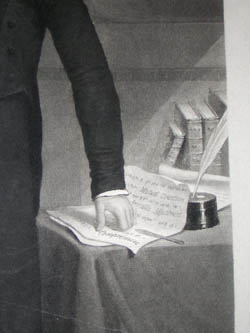 |
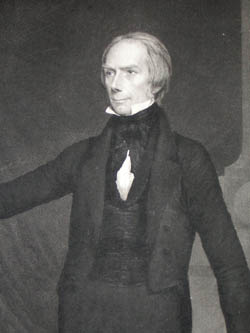
Portrait of the politician and statesman Henry Clay (1777-1852) standing in a library, pointing with his right hand. His other hand rests upon a written manuscript with the words “Mutual Concession,” “Amicable Adjustment,” and “Compromise” legible, representing his key role in the passage of the Missouri Compromise and the Compromise of 1850. Indeed, Clay was popularly known as the Great Compromiser. A large world globe and pile of leather books are stacked on the floor in the lower left corner. A facsimile of Clay’s signature is above the title of the print. According to information given in the print’s margin, Sartain based the print on original drawings and daguerrotypes.
Henry Clay’s long and distinguished political career began in 1803 when he was elected to the Kentucky General Assembly. Appointed to the U.S. Senate at the age of 29, over the ensuing years he served in both the Senate and the House of Representatives, where he also served as Speaker of the House. He was a key player in negotiating the peace between the U.S. and Britain after the War of 1812 and later became John Quincy Adams’ Secretary of State. Clay is perhaps best known for his instrumental role in helping to author the second Missouri Compromise, passed by Congress in 1821, as well as the related Compromise of 1850 almost thirty years later. These laws balanced the concerns of northern and southern states regarding the highly controversial issue of the establishment of slavery in new states entering the Union by agreeing on a geographic boundary line, north of which slavery was prohibited. Clay was opposed to slavery, but the compromises he helped to craft staved off the crisis threatening the Union for decades, until they finally erupted with the Civil War. Though the office of U.S. president eluded Clay, historians consider him among the greatest politicians in American history.
John Sartain was a painter in oil and watercolor, engraver, publisher and arts administrator who introduced pictorial illustration into American periodicals and is considered the father of mezzotint engraving in the United States. He was born in London and emigrated to Philadelphia in 1830, where he became part of an artistic and literary circle that included Thomas Eakins, Mary Cassatt and Edgar Allen Poe. He is known for his mezzotint portraits of important historical figures such as John Sutter, George Washington and Abraham Lincoln, engraving after some of the most prominent artists of his day, including Benjamin West, George Caleb Bingham and Thomas Sully. He also contributed illustrations to periodicals such as Gentleman’s Magazine, Graham’s Magazine and Godey’s Lady’s Magazine, and the magazine he founded in 1849, Sartain's Union Magazine of Literature and Art and about 1,500 illustrations for gift books published between 1830 and 1865. Sartain’s administrative achievements included serving as the secretary of the new Pennsylvania Academy at its founding and as director of the art department of the 1876 International Centennial Exposition in Philadelphia. Sartain is the subject of the book Philadelphia's Cultural Landscape. The Sartain Family Legacy (Katharine Martinez and Page Talbott, eds. Philadelphia, 2000). Sartain’s sons, daughter and granddaughter were also artists, most notably William Sartain (1843-1924). Sartain, his daughter and granddaughter were also associated with the Philadelphia School of Design for Women, later the Moore College of Art.
References:
Aldrich, Brian. “John Sartain.” Poe Forward. http://www.poeforward.com/plutomenagerie/sartain/sartain.htm (13 August 2003).
Clarke, Thomas D. “Henry Clay.” Ashland, the Henry Clay Estate. http://www.henryclay.org/hc.htm (8 March 2005).
Groce, George C. and Wallace, David H. The New-York Historical Society’s Dictionary of Artists in America 1564-1860. New Haven: Yale University Press, 1969. p. 73.
“Henry Clay.” The Columbia Encyclopedia, 6th Ed. New York: Columbia University Press: 2001. Bartleby.com http://www.bartleby.com/65/cl/Clay-Hen.html (8 March 2005).
"John Sartain." 1911 Online Encyclopedia. 2003, 2004. LoveToKnow. http://98.1911encyclopedia.org/S/SA/SARTAIN_JOHN.htm (8 March 2005).
“John Sartain.” Appleton’s Encyclopedia, Virtualogy.com. 2000. http://www.virtualology.com/johnsartain (13 August 2003).
“John Sartain.” The Columbia Encyclopedia, 6th Ed. New York: Columbia University Press: 2002. Bartleby.com.http://www.bartleby.com/65/sa/Sartain.html (13 August 2003).
Zellman, Michael David, dir. American Art Analog. Vol. 2. Chelsea House: New York, 1986. p. 421.