Antoine Maurin (1793-1860) (after)
François Séraphin Delpech (1778-1825) (lithographer)
Lafayette
Paris: c. late 1830s
Lithograph
15.25 x 12.25 inches, overall
Sold, please inquire as to the availability of similar items.

Marquis de Lafayette
19th Century Portrait Lithograph
19th Century Portrait Lithograph
This item is sold. It has been placed here in our online archives as a service for researchers and collectors.
- Please inquire as to the availability of similar items currently in stock, or use the navigation bar above to browse our site for currently available items.
- Find guidelines for the use of images from georgeglazer.com.
- To see more archived items, view our directory.
- Find information about selling your art and antiques.
 |
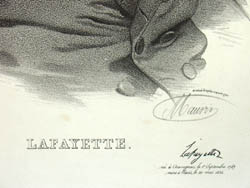 |
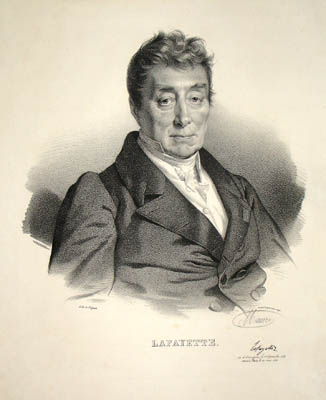
Lithograph portrait of the Marquis de Lafayette (1757-1834), a French general and political leader. He is depicted in civilian clothes, with a direct and intelligent gaze at the viewer. The print bears Lafayette's facsimile signature, lower right, and a brief biographical inscription which dates the publication of this print to after Lafayette's death in 1834. However, given that Delpech died before then, it was probably not the first published version of this lithograph. Lafayette was a popular subject for prints in the first half of the 19th century, and other lithograph portraits of him were also published after Maurin: there were versions in military uniforms, civilian dress, as a bust and as a full-length portrait. For example, there is an undated smaller print lithographed by Delpech after Maurin's portrait in the collection of Lafayette College, which differs from this one in its titling and the fact that it is reversed so the marquis is facing left.
At the beginning of the American Revolution, Lafayette left France and joined George Washington's army, where he was appointed a major general and fought in Valley Forge and Yorktown. He also negotiated for French aid to the colonists. These achievements won him enduring popularity in America for the rest of his life as a popular symbol of the bond between France and the United States. Returning to France in 1782, Lafayette was an active French political figure and military leader in the ensuing years. He also designed the red, white and blue French flag, which remains in use. Lafayette led the French army in a war with Austria, where he was captured and imprisoned, then liberated by Napoleon. He returned to France in 1799. During the French Restoration, Lafayette was a member of the chamber of deputies. He remained highly regarded and influential in French governmental affairs.
Antoine Maurin was a French painter and lithographer, best known for his portraits of celebrated figures of his era. His father, Pierre Maurin (d. 1816), and brother, Nicolas-Eustache Maurin (1799-1850) were also artists. After receiving his early training from his father, he went on to produce paintings as well as lithographs after other artists, including Prud'hon, and series after master paintings in the collections of the art galleries of Dresden and the Palais Royal. His works were exhibited in the Salons of 1834 and 1836. Today one of his paintings is in the collection of the museum at Versailles.
François Séraphin Delpech was a French lithographer, mainly of portraits and costumes after his contemporaries. His portrait lithographs are in the collection of Britain's National Portrait Gallery and the Louvre.
Inscription: “né à Chavagnac, le 1er Septembre 1757/ mort à Paris, le 20 mai 1834” [born in Chavagnac, September 1, 1757/ died in Paris, May 20, 1834].
References:
Bénézit, E. Dictionnaire critique et documentaire des Peintres, Sculpteurs, Dessinateurs et Graveurs. France: Librairie Gründ, 1966. Vol. 3, p. 162 (Delpech); Vol. 6, p. 11 (Maurin).
George, Emilie M. "The Print Collection ca. 1776: Series XI. Portraits: Maurin." Lafayette College: The Marquis de Lafayette Collections. 2002. http://ww2.lafayette.edu/~library/special/marquis/MarquisFindAids/printcollection2.htm#XI (9 February 2006).
"Lafayette." Encyclopedia.com. 2002. http://www.encyclopedia.com/html/L/LafayettMJ.asp (21 March 2002).