Sir Joshua Reynolds (1723-1792) (after)
Francis Hayward (1759-1797) (engraver)
C. F. Gouthier (printer)
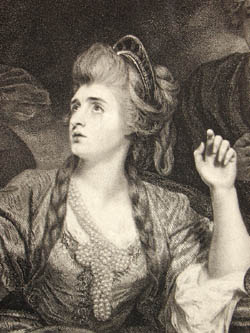
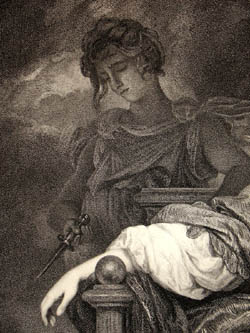
Mrs. Siddons in the Character of the Tragic Muse
Francis Haward, 29 Marsh Street, Lambeth London: June 4, 1787
Stipple engraving, proof with scratched title
22.25 x 16.25 inches, image to ruled border
24.75 x 17.5 inches, overall
Sold, please inquire as to the availability of similar items.

Mrs. Siddons as the Tragic Muse
Engraving after Joshua Reynolds: 1787
Engraving after Joshua Reynolds: 1787
This item is sold. It has been placed here in our online archives as a service for researchers and collectors.
- Please inquire as to the availability of similar items currently in stock, or use the navigation bar above to browse our site for currently available items.
- Find guidelines for the use of images from georgeglazer.com.
- To see more archived items, view our directory.
- Find information about selling your art and antiques.

 |
 |
 |
Portrait of Mrs. Siddons, the leading tragic actress in late 18th century Britain as Melpomene, the Tragic Muse. She sits enthroned in a Romantic landscape of swirling dark clouds, her face and arms aglow. Melpomene’s attributes of a dagger and a cup are held by allegorical figures of Pity and Terror, flanking her dressed in classical garb. The concept may have derived from W. Russell’s poem The Tragic Muse: A Poem Addressed to Mrs Siddons (1783). This print, considered among Hayward’s finest works, was the subject of a controversy when a competitor, Valentine Green, failed to gain the rights to produce the engraving and responded by writing indignant letters to the editor of the Literary Gazette. Reynolds’ original oil, Sarah Siddons as the Tragic Muse, is in the collection of the Huntington Museum, California. He also painted a later version for a patron, now in Britain’s Dulwich Picture Gallery. (See references below to view the paintings.)
Sarah Siddons (1755-1831), née Kemble, was the eldest of twelve children in an acting family. Her Drury Lane Theatre debut at age 19 went poorly, but she eventually established a reputation as an actress in dramas and tragedies touring the English countryside. She made a triumphant return to Drury Lane in 1782, remaining the reigning actress there until 1803, when she moved to the theatre at Covent Garden. She retired in 1812. Siddons excelled at playing tragic Shakespearean roles, particularly Lady Macbeth, in which she impressed her contemporaries with her ability to embody the character. Her fame resulted in portraits by the prominent painters of the day, including Thomas Gainsborough, Thomas Lawrence and Joshua Reynolds, which became the subject of a 1999 exhibition and book published by the Getty Museum, A Passion for Performance: Sarah Siddons and Her Portraitists (Robyn Asleson, ed.).
Sir Joshua Reynolds was the foremost portrait painter in England in the 18th century, and was extremely influential on later generations of artists. His poses were intended to invoke classical values and to enhance the dignity of his sitters. His style incorporated strong lighting, rich color and bravura paint handling. He also made history and "fancy pictures." As first president of the Royal Academy in London, he significantly raised the profile of art and artists in Britain. Reynolds is also known for his eloquent Discourses on Art, delivered to the students and members of the Academy between 1769 and 1790.
Francis Haward was a British engraver, who mainly created prints after paintings by Joshua Reynolds and Angelica Kauffman. He was admitted to the Royal Academy schools in 1776 and first exhibited at the Academy in 1783, continuing to exhibit there on an occasional basis over the ensuing years until his death in 1797. Haward also served as Engraver to the Prince of Wales.
Full title including subtitle: Mrs. Siddons in the Character of the Tragic Muse. To the King’s most Excellent Majesty this Plate is humbly inscrib’d, by Permission, with all Gratitude & Respect, By his most dutiful Subject & Servant, Francis Howard
References:
“A Passion for Performance: Mrs. Siddons and Her Portraitists.” J. Paul Getty Trust. 1999. http://www.getty.edu/bookstore/titles/siddons.html (28 February 2005).
Maxted, Ian. "The London book trades 1775-1800: a preliminary checklist of members." Exeter Working Papers in British Book Trade History. U.K.: Devon Library and Information Services. 20 June 2001. http://www.devon.gov.uk/library/locstudy/bookhist/lonh.html (28 February 2005).
“Mrs Siddons as the Tragic Muse.” Dulwich Picture Gallery. 2003. http://www.dulwichpicturegallery.org.uk/collection/search/display.aspx?irn=252 (28 February 2005).
O'Donoghue, Catalogue of Engraved British Portraits... in the British Museum 47.
Penny, Nicholas (editor), Reynolds, London: Weidenfeld & Nicolson, 1986. pp. 134, 151.
Redgrave, Samuel. A Dictionary of Artists of the English School: Painters, Sculptors, Architects, Engravers and Ornamentists. London: Longmans, Green, and Col., 1874. p. 194.
“Sarah Siddons.” Encyclopaedia Brittanica presents Shakespeare and the Globe: Then and Now. http://search.eb.com/shakespeare/micro/545/97.html (28 February 2005).
“Sarah Siddons: Art, Theater and Celebrity in Georgian Britain.” The Huntington. 1999. http://www.huntington.org/ArtDiv/Siddons/Siddons.htm (28 February 2005).
"Sir Joshua Reynolds." The Grove Dictionary of Art. New York: Macmillan. 2000. Artnet.com.http://www.artnet.com/library/07/0717/T071710.asp (15 April 2002).