Francis Calcraft Turner (c. 1782-1846) (after)
James R. Mackrell (act. mid 19th C.) (engraver)
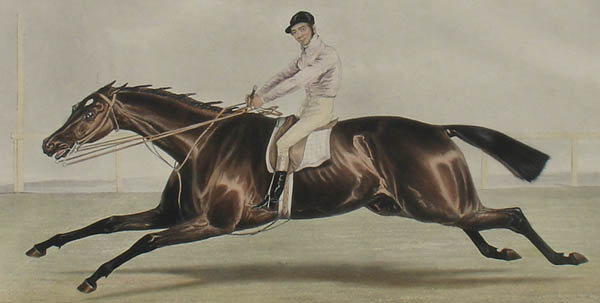
Conolly on Coronation, Winner of the Derby Stakes at Epson, 1841
Ackermann, London: August 18, 1841
Hand-colored aquatint
20.75 x 25.75 inches, platemark
27 x 32 inches, overall
Sold, please inquire as to the availability of similar items.

Conolly on Coronation, Winner at Epson, 1841
British Horse Racing Sporting Print
British Horse Racing Sporting Print
This item is sold. It has been placed here in our online archives as a service for researchers and collectors.
- Please inquire as to the availability of similar items currently in stock, or use the navigation bar above to browse our site for currently available items.
- Find guidelines for the use of images from georgeglazer.com.
- To see more archived items, view our directory.
- Find information about selling your art and antiques.

Full sheet
Detail

Title engraved below print
Large portrait of the jockey Patrick Conolly riding the champion racehorse Coronation, who won the Derby Stakes at Epson Downs in 1841. This print is listed in Mackenzie, a standard reference on English prints (see References below). The Derby at Epson Downs was (and still is) one of the prestige events in thoroughbred horse racing. Patrick Conolly had ridden a previous Derby winner in 1834. In 1841, he rode Coronation for Abraham T. Rawlinson, “Winning in a Canter, -- by three lengths,” according to an inscription beneath the print.
Frank Calcraft Turner was a British painter of horses and sporting scenes. A member of the Society of British Artists, he exhibited in London from 1810 to 1846, at the Royal Academy, the British Institution and at Suffolk Street.
James R. Mackrell was an aquatint engraver of sporting subjects working in London. He engraved hunting and equestrian subjects after his contemporaries, including J.F. Herring, F.C. Turner and W.J. Shayer.
Ackermann & Co. was a prominent British publisher and printseller. The firm was founded by Rudolph Ackermann (1764-1834), publishing as R. Ackermann from 1795 to 1829. Ackermann was born in Germany and came to England in the 1780s. He pioneered lithography in Britain (though frequently working with color-printed etchings and aquatints), and became a leading publisher of fine colorplate books, decorative prints and magazines, as well as sheet music of the Regency period. In 1797, Ackermann relocated the business premises to 101 Strand, which were known by 1798 as “The Repository of Arts,” also the title of a periodical with a large number of prints that he published from 1809 to 1828. As suggested by the full title of the publication, Ackermann's Repository of the Arts, Literature, Commerce, Manufactures, Fashions and Politics, the subject matter of the Repository was wide ranging. Among the most influential and popular images in the series were studies of Regency decorative arts, interior design and fashion, as well as various city and country views. Ackermann was a major patron of British artists and designers, notably the famous caricaturist Thomas Rowlandson (1756-1827), whose works were featured in the famous set of London interiors and exteriors entitled Microcosm of London (R. Ackermann, London, 1808-10). Ackermann also manufactured and sold art supplies. In 1829, Rudolph transferred the business to three of his sons, who traded as Ackermann & Co. from 1829 to 1859. During the 20th century the company had offices in London, Paris, New York and Chicago. The business continued until the end of the century, last operating as Arthur Ackermann and Son.
Full publication information: “London: Published August 18th 1841, by Ackermann & Co. 96, Strand.”
References:
Bénézit, E. Dictionnaire critique et documentaire des Peintres, Sculpteurs, Dessinateurs et Graveurs. France: Librairie Gründ, 1966. Vol. 8, p. 408.
“Epson Derby Winners 1780 -.” RacingBetter.co.uk. 2008. http://www.racingbetter.co.uk/races/derby/winners.html (29 July 2008).
Mackenzie, Ian. British Prints: Dictionary and Price Guide. Woodbridge, Suffolk, England: Antique Collectors Club, 1987. p. 215.
Maxted, Ian. "The London book trades 1775-1800: a preliminary checklist of members." Exeter Working Papers in British Book Trade History. U.K.: Devon Library and Information Services. 24 January 2005. http://www.devon.gov.uk/etched?_IXP_=1&_IXR=111144 (4 May 2007).
"Rudolph Ackermann." National Portrait Gallery. May 2007. http://www.npg.org.uk/live/search/person.asp?LinkID=mp06540 (4 May 2007).