John Groth
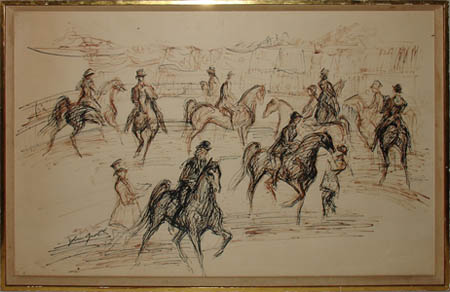
[Horse Show]
American: c. 1950s
Pen and ink
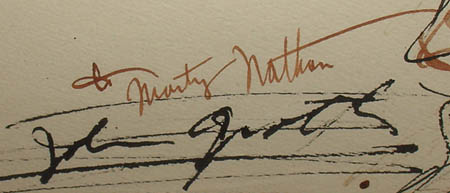
Inscription lower left: "To Marty Nathan, John Groth"
26.5 x 39.5 inches, image
28.25 x 41.5 inches, frame
Sold, please inquire as to the availability of similar items.
To see other John Groth drawings and paintings on our site, use our site search engine.
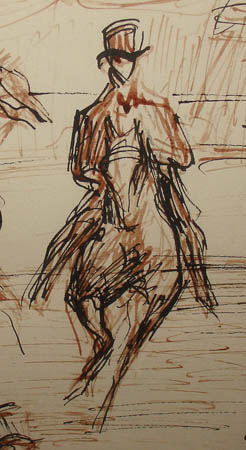
Large, pen-and-ink drawing, freely executed in black and sepia inks, showing formally dressed riders in a ring, with the surroundings lightly indicated in the background. Some horses are in motion while others stand still. A figure standing in the midst of the riders toward the left, perhaps a judge, holds some papers. The lively sense of motion and the sports-related subject matter are characteristic of Groth’s work.
John August Groth was a painter and illustrator best known for his sports and war subjects. Born in Chicago, he studied at the Art Institute of Chicago. He was discovered at the age of 25 by Arnold Gingrich, founding editor of Esquire magazine, who happened by Groth’s work at an outdoor art fair and hired Groth to fill out the first issue with 17 pages of illustrations and gave him the title of art director. Groth held that position for the next four years, until he left Chicago for New York. From the beginning, Groth gravitated toward depictions of men in action, in a style he called "speed line," in which he made gestural line renderings based on on-site sketches and fleshed out the form with freely brushed watercolors.
An adventurous spirit, Groth was an artist-correspondent during World War II, the Korean and Vietnam wars, drawing battlefield scenes from sketches made on site, and impressing no less than Ernest Hemingway, who said: “He gets to the essence of war.” Yet he was by all accounts a nonviolent man and was among the artists attending the First Congress of American Artists Against War and Fascism in 1936, along with Stuart Davis, Peter Blume and Margaret Bourke-White. In 1945, he published Studio: Europe, a collection of drawings made during World War II with an introduction by Hemingway. This book included front line battle scenes, villages, and Picasso’s studio. In 1952, Groth published Studio: Asia, a narrative and pictorial document of the Korean War and his travels to Japan, China and Indochina.
His sporting subjects included everything from boxing and baseball to the unusual sports from farflung corners of the world depicted in his book John Groth’s World of Sport (1970). These included Thai kite fighting and an assortment of chaotic and dangerous contests involving men on horseback in the Middle East, Asia and Africa. Groth’s works are in the collection of the National Portrait Gallery, the U.S. Army Center of Military History and the Naval Historical Center in Washington, the United States Air Force Collection, as well as the National Art Museum of Sport, Indianapolis.
References:
Groth, John, Pat Smith and Arnold Gingrich. John Groth’s World of Sport. New York: Winchester Press, 1970. pp. 5-10, 36-39, 150.
"John Groth." National Art Museum of Sport. http://www.namos.iupui.edu/artists/groth.htm (3 March 2003).
“John Groth.” United States Air Force Collection. http://www.afapo.hq.af.mil/artists/artistsdetail.cfm?Letter=G&value=251 (20 April 2004).