Alfred James Munnings (1878-1959) (after)
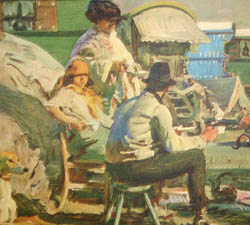
Gypsies on Epsom Downs, Derby Week
Frost & Reed, Bristol & London: 1927
Offset color lithograph
Signed in pencil lower right: A.J. Munnings
Titled in pencil in unknown hand, lower margin
16.25 x 22 inches, image
19.25 x 25.5 inches, plate mark
23.5 x 28.75 inches, overall
Sold, please inquire as to the availability of similar items.

Gypsies on Epsom Downs, Derby Week
Alfred James Munnings, Signed Print
Alfred James Munnings, Signed Print
This item is sold. It has been placed here in our online archives as a service for researchers and collectors.
- Please inquire as to the availability of similar items currently in stock, or use the navigation bar above to browse our site for currently available items.
- Find guidelines for the use of images from georgeglazer.com.
- To see more archived items, view our directory.
- Find information about selling your art and antiques.

  |
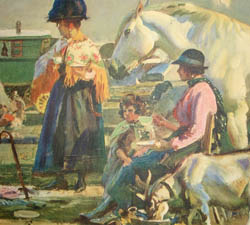  |
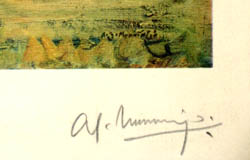
Race horses are shown among Gypsies in their encampment on the hills outside the race course at Epsom Downs. The Gypsies drink tea among their wagons and tents. The original oil painting by Alfred James Munnings was one of three large works on horse racing themes he exhibited at the Royal Academy exhibition of 1926. Two depicted the ceremonial arrival of the King and Queen of England at the races at Ascot, and the other was this colorful genre scene of the traveling gypsy horse traders and trainers. Munnings had been fascinated by gypsies for many years, painting his first picture of them as a young man in 1902. He spent time in their camps, getting to know them and making sketches on site. Frost & Reed, London art dealers, owned the original oil painting by Munnings by 1926, and sold it in 1927. From 1920s into the ‘50s, they published prints after Munnings paintings. The original painting sold at auction at Sotheby’s New York, on April 25, 2006, for $4,104,000.
Sir Alfred James Munnings was a British painter of landscapes, sporting and genre scenes, with an enduring reputation for his equestrian portraits. According to Sotheby’s, in describing the original painting, “Munnings’ mastery of horses of all types and dispositions often brought him comparisons to George Stubbs” while the striking skies in his landscapes are reminiscent of those of John Constable. “What is less often observed is how carefully Munnings had studied the social painters of the eighteenth- and nineteenth-centuries, the artists like Wootton, Gainsborough, or Wright of Derby, who wrote the social history of the British nation in their paintings. Munnings was a master of the conversation piece as well as the sporting picture. He could paint the king and queen at the races one week, the traveling people the next.”
Perhaps Munnings’s keen observations of social behavior derived in part from his study of art, but it seems likely that he was also informed by his experiences as a rural working class man moving into the rarefied realms of the Royal Academy and aristocratic patronage in class-conscious England. He grew up in the countryside of Suffolk, the son of a miller, and at age 14 began a six-year apprenticeship with a firm of Norwich lithographers, studying painting in evening courses at the Norwich School of Art. After his apprenticeship, he set his sights on becoming an artist, persevering despite losing sight in one eye around the age of 20. The following year, in 1899, two of his paintings were shown at the Royal Academy Summer Exhibition. He also studied in Paris around 1902-03. A few years later, he went to Cornwall and affiliated himself with the Newlyn School of artists, who were interested in plein air painting. During World War I, Munnings accompanied the Canadian Cavalry Brigade to France as an official war artist. In 1919, he painted his first racehorse, a Grand National winner, and became an associate of the Royal Academy, achieving full membership in 1926, and serving as president from 1944-49. He was knighted in 1945, and received the additional title of Knight of the Royal Victorian Order in 1947. After Munnings’s death, his home, Castle House, Dedham became a museum of his work. Other museums housing his paintings include the National Museums, Liverpool, England, and the Art Gallery of New South Wales in Sydney, Australia. As of April 2006 a catalogue raisonné of Munnings’s works was in production.
Frost & Reed is a British firm dealing in fine art, established in 1808. The company currently has galleries in both London and New York.
References:
“19th Century European Art including Sporting Paintings, Sale N08181, Lot 166.” Sotheby’s. 25 April 2006. http://search.sothebys.com/jsps/live/lot/LotDetail.jsp?sale_number=N08181
&live_lot_id=166 (10 April 2006).
Booth, Stanley. “Sir Alfred Munnings.” Castle House. http://siralfredmunnings.co.uk/ (10 April 2006).
“Further Reading: The Friesian Bull by Sir Alfred James Munnings.” National Museums, Liverpool. December 2004. http://www.liverpoolmuseums.org.uk/nof/aotm/furtherReading.asp?id=243&venue=7 (10 April 2006).
“Sir Alfred James Munnings.” Frost & Reed on Artnet.com. http://www.artnet.com/Galleries/Artists_detail.asp?G=&gid=408&which=&aid=552965 (10 April 2006).
“Sir Alfred James Munnings.” The Grove Dictionary of Art. New York: Macmillan. 2000. Artnet.com. http://www.artnet.com/library/06/0603/T060360.asp (10 April 2006).