
Pair of 19th C. British Racehorse Portraits
Hermit and Sir Tatton Sykes
Hermit and Sir Tatton Sykes
This item is sold. It has been placed here in our online archives as a service for researchers and collectors.
- Please inquire as to the availability of similar items currently in stock, or use the navigation bar above to browse our site for currently available items.
- Find guidelines for the use of images from georgeglazer.com.
- To see more archived items, view our directory.
- Find information about selling your art and antiques.
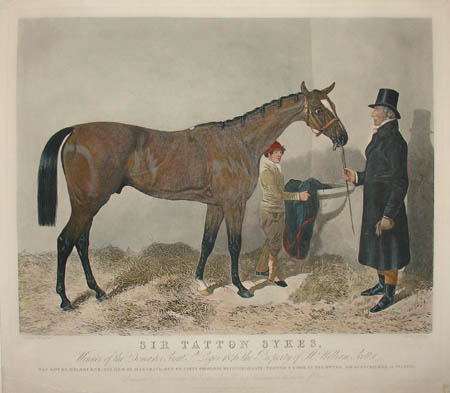
Sir Tatton Sykes after J.F. Herring, Sr. |

Hermit after Harry Hall |
Detail of frame
Harry Hall (1813-1882) (after) |
John Frederick Herring, Sr. (1795-1865) (after) |
Sold, please inquire as to the availability of similar items.
Two portraits of important mid 19th century British racehorses, each published by Baily, London, being sold as a pair. One is a portrait of the racehorse Hermit, commemorating his 1867 victory in Britain’s most prestigious thoroughbred race, the Derby Stakes at Epsom Downs. The gleaming chestnut horse stands on a bed of straw in a stable, with horse blankets draped behind him. The other is a portrait of the racehorse Sir Tatton Sykes with a stable boy and the elegantly dressed aristocrat Sir Tatton Sykes, for whom the horse was named. The print commemorates his winning the Doncaster Great St. Leger race of 1846. Portraits of champion racehorses were a popular genre in British art of the era, but this one has an unusual touch of humor, as the horse sticks out his large gray tongue and licks the cane being held by the surprised and amused gentleman.
Both Hermit and Sir Tatton Sykes had stories that captured the imagination of the 19th century British racing public. Hermit had been bred by William Blenkiron in 1864, sold to Henry Chaplin, and then sent by Captain James Machell, the manager of Chaplin’s horses, to a Newmarket yard operated by the brothers Charles and George Bloss. A few years later, when the 1867 Derby was run, Hermit’s young jockey, John Daley, guided the horse to first place, earning Chaplin and Machell a fortune. Hermit went on to win other important races that year. After he was retired for breeding, his descendants were highly successful and he became “one of the most popular and fashionable stallions of his time. He was leading sire in Britain seven years in succession, 1880-1886” (Martiniak).
Sir Tatton Sykes was born in 1843 and purchased by the jockey William Scott, a colorful character and notorious alcoholic, who initially named the horse Tibthorpe. Scott rode the horse to victory in the 2,000 Guineas race of 1846, after which, “according to a possibly apocryphal story, he dismounted, got down on his knees, and thanked God, ‘for having sent me a hell of a horse’ (Erigero).” After that race, Scott renamed the horse after Sir Tatton Sykes, owner of a Yorkshire estate who had employed Scott as a jockey. Scott raced the horse in the Derby, but was so drunk he failed to keep the horse on course. Before the St. Leger, his friends kept careful tabs on him before the race to make sure he stayed sober. The human Sir Tatton Sykes, rooting for his namesake, “kept a promise he made to Scott that if he won, he would act as groom to the horse to lead him in to the unsaddling enclosure following the race. This event was commemorated several times over in paintings and subsequent prints (Erigero),” and this one possibly alludes to that event.
Harry Hall was a British sporting and landscape artist who made a number of portraits of winning racehorses. He exhibited in London from 1838 to 1886 at the Royal Academy, the British Institution and Suffolk Street. His paintings are in the collection of the Tate Gallery in London and the National Library of Australia.
John Frederick Herring (1795-1865) was an English sporting and equestrian painter. It is said that before becoming an artist, he drove a stagecoach. Whether or not this is true, it is evident from his paintings that he was deeply familiar with horses, their posture and personalities, and the specific details of their surroundings. He specialized in painting English thoroughbred racehorses and farmyard scenes such as these, and they were frequently made into prints. His son, J.F. Herring, Jr., continued the family tradition, painting similar horse and sporting scenes.
William Summers was a British aquatint engraver, caricaturist and lithographer or sporting, military and naval subjects. He was a pupil of J. Harris III, with whom he also collaborated. His engravings include plates after the noted sporting painters J.F. Herring, Henry Hall and Henry Alken.
James R. Mackrell was an aquatint engraver of sporting subjects working in London. He engraved hunting and equestrian subjects after his contemporaries, including J.F. Herring, F.C. Turner and W.J. Shayer.
A.H. Baily was a British publisher operating in London during most of the 19th century. In addition to books and prints, they also published periodicals, including The Comic Annual, Sporting and Baily’s Magazine of Sports and Pastimes.
Caption under image, Hermit: “Hermit. Winner of the Derby Stakes at Epsom 1867. The Property of Henry Chaplin, Esq. Sired by Mr. Blenkiron in 1864, by Newminster Out of Seclusion. Trained by Bloss. Ridden by John Daley. London Published July 9th 1867, by A.H. Baily & Co., Cornhill.”
Caption under image, Sir Tatton Sykes: “Sir Tatton Sykes. Winner of the Doncaster Great St. Leger 1846 the Property of Mr. William Scott. Was got by Melbourne, his dam by Margrave, out of Patty Primrose by Confederate, trained and rode by the owner. 149 subscribers, 12 started. Dedicated by permission to Sir Tatton Sykes, Bart. of Stedmere in the county of York. London: Baily Brothers, Royal Exchange Building, Cornhill. Paris: Gambart, Junin & Cie. Deposé. Vide Baily’s Racing Register.”
References:
Bénézit, E. Dictionnaire critique et documentaire des Peintres, Sculpteurs, Dessinateurs et Graveurs. France: Librairie Gründ, 1966. Vol. 4, p. 559 (Hall).
Erigero, Patricia. “Melbourne.” Thoroughbred Heritage Portraits. 1997-2005. http://www.tbheritage.com/Portraits/Melbourne.html (8 August 2008).
Mackenzie, Ian. British Prints: Dictionary and Price Guide. Woodbridge, Suffolk, England: Antique Collectors Club, 1987. pp. 215 (Mackrell), 307 (Summers).
Martiniak, Elizabeth. “Hermit.” Thoroughbred Heritage Portraits. 1997-2005. http://www.tbheritage.com/Portraits/Hermit.html (11 August 2008).