John Nost Sartorius (1759-1828) (after)
John Whessell (c.1760-after1797) (engraver)
Diamond
Hambletonian
John Haris, London: November 1, 1799
Aquatints
15.5 x 19.25 inches, image and text
17 x 20.75 inches, overall
Sold, please inquire as to the availability of similar items.

Hambletonian and Diamond, British Racehorses
Sartorius Horse Prints, London: 1799
Sartorius Horse Prints, London: 1799
This item is sold. It has been placed here in our online archives as a service for researchers and collectors.
- Please inquire as to the availability of similar items currently in stock, or use the navigation bar above to browse our site for currently available items.
- Find guidelines for the use of images from georgeglazer.com.
- To see more archived items, view our directory.
- Find information about selling your art and antiques.
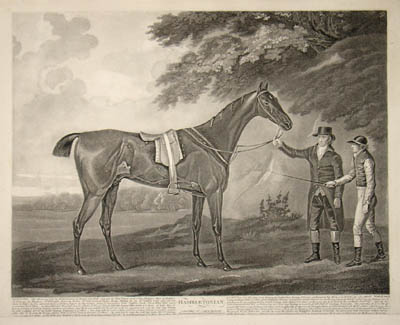 Hambletonian |
 Diamond |
 |
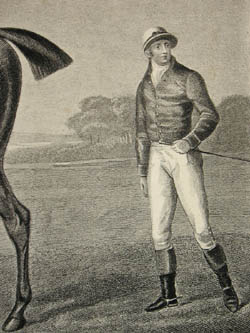 |
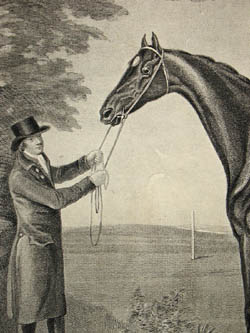
Diamond, details |
|
 |
 |
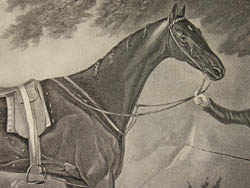 |
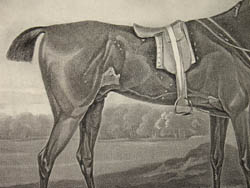
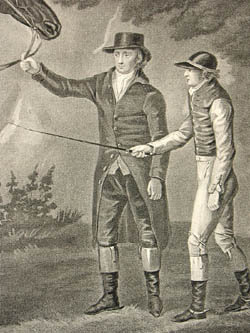
Hambletonian, details |
||
Pair of portraits of famous British racehorses based on the original paintings of the renowned 18th century British sporting artist John Nost Sartorius. Both prints show the horses attended by a jockey and another man, probably the owner, who holds the reins.
In Hambletonian, an extensive text in the lower margin gives a history of the horse, including races, statistics and past owners. It begins, “This Horse was bread (sic) by Mr. Hutchinson of Skipton near York, was got by King Fergus out of ye Grey Highflyer Mare by Highflyer, the Gr. Nominia by Matchem,” and ends by noting “he never was beat but once when running, at the York, Aug[us]t Meeting 1797, he ran out of ye Course when he was winning easy. He is now in Training at Richmond Yorkshire.”
The text in the lower margin of Diamond provides a similar history of the horse, including numerous wins. It begins, “Was bred by F. Dawson Esqr. Of Newmarket. He was got by Highflyer. Dam by Matche. Gr. Barbara beating Hermione & Vixen,” and ends by noting that the horse is the property of “Joseph Cookson Esqr.”
Portraits of horses were very popular in Britain in the 18th and 19th centuries. An artist would be commissioned to paint a portrait of an aristocratic rider with his foxhunting or race horse, sometimes accompanied by a jockey or horse handler. Painters such as John Nost Sartorius, John Herring, and George Stubbs were kept busy meeting this demand. In addition to horse portraits, many artists of the period, notably Henry Alken, painted action horse scenes, sometimes comical, such as the hunt or steeple chase races. Many of these horse paintings were then issued as prints.
John Nost Sartorius was from a British family of sporting artists that included his father, Francis, and his son, J.F. John mostly drew and painted horses, dogs and hunting scenes, many of which were engraved for the print trade. He exhibited at the Royal Academy from 1781 to 1824. His horse paintings are in the collections of the Tate Gallery in London, the British Government Art Collection, and the Fine Arts Museums of San Francisco, among others.
John Whessell was an English engraver working in London at the end of the 18th century. He engraved after Serres, Stothard, Singleton, Sartorius and Gainsborough, among others.
John Haris was a London map and printseller, active from 1771 to 1812.
References:
Maxted, Ian. "The London book trades 1775-1800: a preliminary checklist of members." Exeter Working Papers in British Book Trade History. U.K.: Devon Library and Information Services. 20 June 2001. http://www.devon.gov.uk/library/locstudy/bookhist/lonh.html (Haris) (25 January 2005).
Williamson, George C., ed. Bryan's Dictionary of Painters and Engravers. London: G. Bell and Sons: 1930. Vol. 5, p. 24 (Sartorius) Vol. 5, p. 359 (Whessell).