George Stubbs (1724-1806) (after)
George Townly Stubbs (1756-1815) (engraver)
Baronet
Edward Orme, London: June 4, 1817 (third state, c. 1819)
Color printed stipple with etching finished by hand coloring
Watermarked 1819; papermaker’s name watermarked but indiscernible
16 x 19.5 inches, plate
17.5 x 22.5 inches, overall
Sold, please inquire as to the availability of similar items.

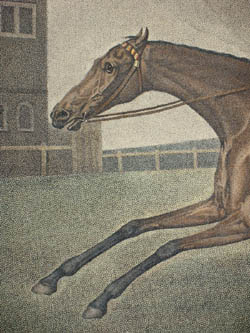
Baronet - Horse and Jockey
George Stubbs Etching
George Stubbs Etching
This item is sold. It has been placed here in our online archives as a service for researchers and collectors.
- Please inquire as to the availability of similar items currently in stock, or use the navigation bar above to browse our site for currently available items.
- Find guidelines for the use of images from georgeglazer.com.
- To see more archived items, view our directory.
- Find information about selling your art and antiques.

 |
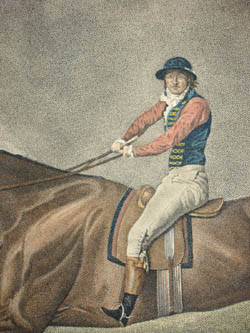 |
Samuel Chifney, the jockey of the Prince of Wales, rides the prince’s horse “Baronet,” in an accomplished and controversial picture by the most famous British horse and animal artist of the 18th century, George Stubbs, and engraved by his son George Townly Stubbs. The original painting is in the collection of Lord Halifax. The print was published in three states, this example being the third state, as evident from the publisher’s information.
Stubbs expert Christopher Lennox-Boyd describes the horse Baronet, and the history of this print:
Baronet, a bay colt by Vertumnus out of Penultima by Snap, was foaled in 1785, bred by Lord Sherborne, and sold to Sir Walter Vavasour and then to the Prince of Wales. He began racing in 1789 but his best year was 1791 when he won the hotly contested 2,000-guinea Oatland Stakes – when according to Cook (I, p. 361) the Prince won over 17,000 pounds sterling in bets – and everything else that he ran for, including King’s Plates at Winchester, Lewes, Canterbury and Newmarket. The Sporting Magazine commented that Samuel Chifney, the Prince of Wales’s jockey who is shown here, ‘gained much credit for the skill and dexterity he showed’ in jockeying Baronet to victory in the Oatland Stakes and added (III, p. 213): ‘Mr. Stubbs has taken great pains to give the character and style of riding of this celebrated jockey, and the horse upon which he gained so much fame. There is something very singular in this picture; the horse’s legs are all off the ground, at that moment when raised by the motion of muscular strength – a bold attempt, and as well perfectd: this attitude has never been yet described but by Mr. Stubbs.’ Chifney’s ‘dexterity’ became the subject of bitter controversy when he ran another of the Prince’s horses, Escape, to defeat and then victory in successive heats at Newmarket in 1792. The Prince was censured by the Jockey Club and withdrew from the Turf rather than disown Chifney. To some extent, therefore, this was a controversial print.
(Lennox-Boyd, 238)
George Stubbs (1724-1806) was one of the greatest sporting artists of Georgian England. He combined science and art by painting animals with anatomical precision. After a visit to Rome and a period of residence in Liverpool, he returned to England in 1760. He also drew horses based on dissections, and in 1766 published a monumental series of engravings, Anatomy of the Horse, which cemented his reputation as a master of the subject. His vast body of work includes paintings of the prize horses of England of the late 18th century, often with their proud owners or trainers. He also painted hunting scenes, and wild animals such as lions and tigers, including some with lions stalking horses. Stubbs served as president of the Society of Artists in 1773 and though he had his quarrels with the Royal Academy, he exhibited there periodically and was elected as an Associate in 1780. Many of his paintings are in the world’s major museums, with a large number represented in the Yale Center for British Art (Paul Mellon Collection). Some of the greatest engravers and printers of the day were engaged to render Stubbs' animal pictures as prints, including William Woollett (1735-1785), and Stubbs’ son, the printmaker George Townly Stubbs (1756-1815) (sometimes spelled “Townley”).
Edward Orme (b. 1774) was a London artist and printseller, serving as printseller in ordinary and engraver to King George III from 1799 to 1820, and to the Prince of Wales (later King George IV) from 1817 to 1830. He exhibited at the Royal Academy between 1801 and 1803.
Full publication information on print: Edward Orme, New Bond Street, corner of Brook Street, London.
References:
Lennox-Boyd, Christopher, et al. George Stubbs: The Complete Engraved Works. London: Stipple Publishing Limited, 1989. Item 100, p. 238.
Maxted, Ian. "The London book trades 1775-1800: a preliminary checklist of members." Exeter Working Papers in British Book Trade History. U.K.: Devon Library and Information Services. 24 January 2005. http://www.devon.gov.uk/library/locstudy/bookhist/lonn.html (Orme) (6 April 2005).
Williamson, George C., ed. Bryan's Dictionary of Painters and Engravers. London: G. Bell and Sons: 1930. Vol. 5, pp. 139-140 (Stubbs).