Jacques Callot (1592-1635) (artist and engraver)
Le Siège de la Rochelle
Nancy: 1631 [but later restrikes]
Etchings, uncolored, on wove paper
One signed in plate: Jac. Callot fec.
22.25 x 17.75 inches, plate mark (average approximate)
25 x 19.75 inches, overall (average approximate)
Sold, please inquire as to the availability of similar items.

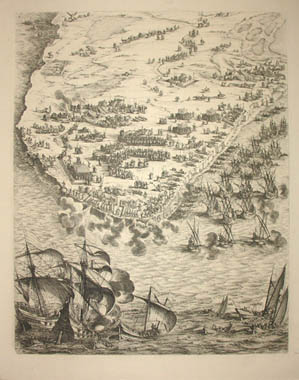
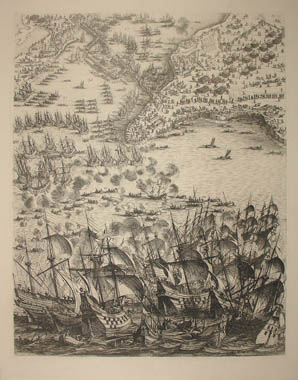
Naval Battle Scene: The Siege of La Rochelle
Set of 3 Jacques Callot Prints
Set of 3 Jacques Callot Prints
This item is sold. It has been placed here in our online archives as a service for researchers and collectors.
- Please inquire as to the availability of similar items currently in stock, or use the navigation bar above to browse our site for currently available items.
- Find guidelines for the use of images from georgeglazer.com.
- To see more archived items, view our directory.
- Find information about selling your art and antiques.
 |
 |
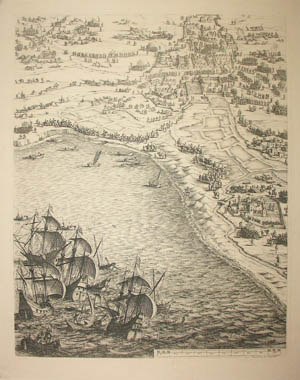 |
The three prints together forming a large battle scene. |
||
 |
 |
 |
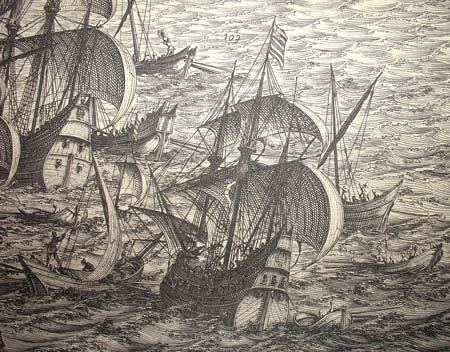 |
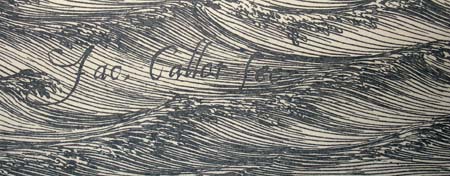
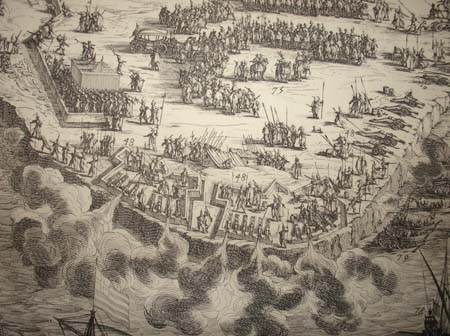
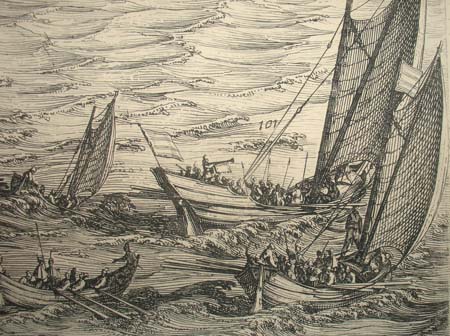
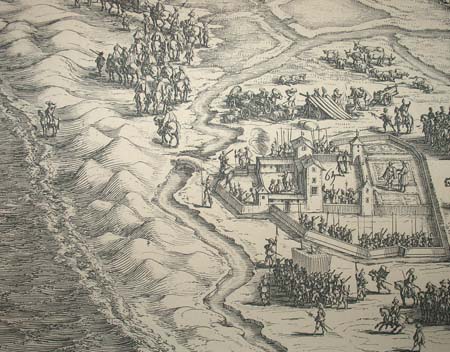
Details from the prints
Three prints from a series of six that combine into one monumental composition depicting incidents in the siege of the port of La Rochelle, a dramatic series of battles at the beginning of the 17th century that claimed the lives of two-thirds of its citizens. The three offered prints are the bottom section, which focuses on the naval part of the siege (the other three prints, not offered here, form the upper section of land battle). King Louis XIII commissioned them from the renowned engraver Jacques Callot to celebrate his victory over the wealthy Protestant city, one of the few remaining holdouts resisting Louis XIII’s consolidation of his rule over France. Callot skillfully incorporated several events from the 14-month siege into a topographical rendering of the town, its walls, ramparts and three towers.
In August 1627, Cardinal Richilieu attempted to occupy La Rochelle and establish the rule of Louis XIII. Their religious liberty threatened, the citizens resisted. There followed the lengthy siege, in which the Royalist forces eventually prevailed by fending off the English army, which attempted to assist La Rochelle, and by cutting off the town’s food supply by digging moats separating the city from the countryside on the land and creating dams and blockades at sea. All these events are documented in Callot’s engravings. The war was essentially won by decimating the population through starvation. On November 1, 1628, the leaders of La Rochelle turned over the keys to the city to Louis XIII, an event depicted in the upper portion print, which shows the king’s procession entering the city. However, the citizens’ tenacity during the siege was rewarded with their retaining the right to worship in their Protestant faith.
Jacques Callot was a French etcher, engraver, painter and draftsman, considered among the foremost printmakers in the Western tradition. He revolutionized the etching medium through technical innovations, and his fluid Mannerist style and unusual subject matter and compositions influenced later generations of printmakers. Callot was one of the earliest etchers to employ repeated biting of the plate, and his command of the technique influenced later artists. His patrons included members of the aristocracy in Italy, France, and Spain. A colorful character, as a boy Callot twice ran away from home with the idea of becoming an artist in Italy; both times he was returned to his parents. They relented when he was 16, and he obtained a working apprenticeship in Rome. He stayed in Italy until 1621, mainly in Florence, where he was part of circle of artists including the architect and etcher Giulio Parigi and worked under the patronage of the Medici duke Cosimo II. He returned to his hometown of Nancy in Lorraine, now part of France, but then an independent duchy, and basically remained there for the rest of his life.
Callot’s subjects were wide ranging, from genre series of figures in different costumes and poses, sometimes referred to as "grotesques" for the hunchbacks, beggars and marginal members of society depicted. These series include the Caprices, the Fantasies and Italian Vagabonds. Having witnessed the Thirty Years War firsthand, he also produced several series of prints on military subjects, some more documentary, some pointedly showing the damaging effects of war on ordinary people. His impressive large topographical prints documenting military scenes include Le Siège de Bréda (1627-29) designed for the Infanta Isabella, Spanish regent of the Lowlands. This in turn won him the commission from Louis XIII for Siège de la Citadelle de Saint-Martin dans l'Ile de Ré par Louis XIII en 1625 (1628-31) and Le Siège de La Rochelle (1631) which cemented Callot’s artistic reputation. Callot also depicted The Miseries of War in a set of prints published in 1632-33, dramatic depictions of human venality and suffering during wartime which anticipated the antiwar prints of Goya almost two centuries later.
References:
Bénézit, E. Dictionnaire critique et documentaire des Peintres, Sculpteurs, Dessinateurs et Graveurs. France: Librairie Gründ, 1966. pp. 263-264.
Hart, David M. Jacques Callot and the Miseries of the Thirty Years War. 7 November 2003. War and Art. (22 March 2005).
Hind, Arthur M. A History of Etching and Engraving from the 15th Century to the Year 1914. London: Constable and Co., 1927. pp. 158-160.
"Jacques Callot." International Fine Print Dealers Association. http://www.printdealers.com/artist_template.cfm?id=227 (22 March 2005).
"La Siege de la Rochelle de Jacques Callot." Musée d'Orbigny-Bernon de La Rochelle. http://perso.wanadoo.fr/musees-la-rochelle/orbigny/tresor2.htm (21 March 2005).