Auguste Louis Rossel de Cercy (1736-1804) (after)
François-Nicolas-Barthélemy Dequevauviller (1745-c. 1807) (engraver)
L. Aubert (writer of inscription)
Damour (printer)
Combat Naval Livré le 6, Octobre 1779 par Mr. Du Couëdic Lieutenant de Vaisseau
[Naval Combat, October 6, 1779, by Monsieur Du Couëdic, Lieutentant of the Vessel]
Mérigot le Jeune and L. Aubert: Paris, c. 1791
Hand-colored engraving
21.5 x 28.75 inches, overall
Sold, please inquire as to the availability of similar items.

Revolutionary War French and British Frigate Battle
Auguste Louis Rossel, Paris: c. 1791
Auguste Louis Rossel, Paris: c. 1791
This item is sold. It has been placed here in our online archives as a service for researchers and collectors.
- Please inquire as to the availability of similar items currently in stock, or use the navigation bar above to browse our site for currently available items.
- Find guidelines for the use of images from georgeglazer.com.
- To see more archived items, view our directory.
- Find information about selling your art and antiques.
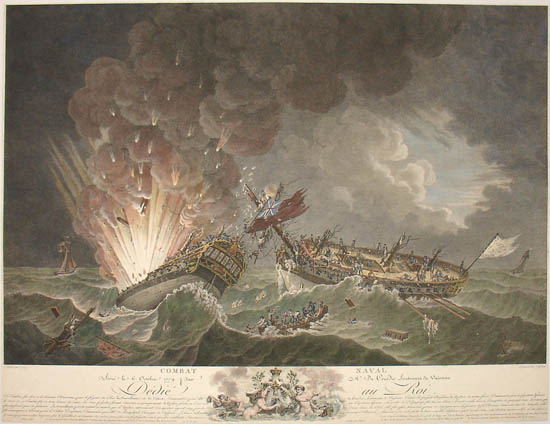

Dramatic scene of the aftermath of a naval battle that took place on October 6, 1779, between the French frigate La Surveillante, commanded by Captain Charles Louis du Couëdic (1740-1780), and the British frigate HMS Quebec, commanded by Captain George Farmer (1732-1779). Though this event took place off the coast of Brittany, it was precipitated by the American Revolutionary War, during which the French sided with the Americans against the British. The print is dedicated to Louis XVI, King of France.
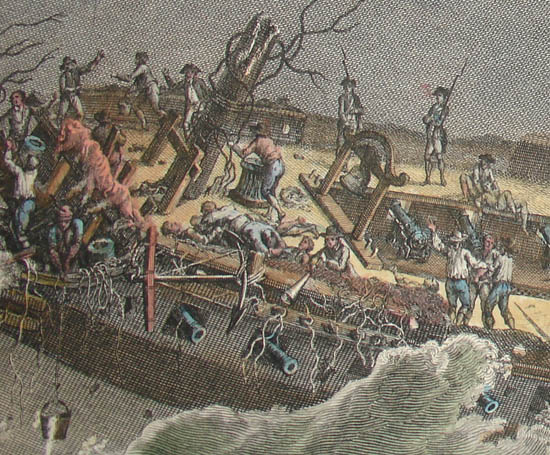
In the battle, the ships were evenly armed, and each accompanied by a cutter, which in this print can be glimpsed sailing in the distance. After three and a half hours of fierce fighting and heavy swells, the two frigates were severely damaged, their masts toppled. As the French sailors boarded the British ship, a fire broke out on it. The print shows what happened next: the two sides stopped fighting and worked together to rescue as many men as possible, with Captain Couëdic sending his only lifeboat. Sailors, are shown as they cling to floating wreckage, or sit in the crowded lifeboat. 43 British sailors were rescued by the French, but many more perished, including Captain Farmer, who died aboard his ship when it exploded. Couëdic died of his wounds in January 1780, and was admired for his courage and compassion by both the French and the British.
Beneath the title and dedication to the King of France, a lengthy inscription tells the story of the battle in the lower margin on either side of an elaborate baroque illustration featuring Poseidon, a mermaid and a merman blowing a shell horn guiding a boat bearing laurel leaves and a crown radiating light. The inscription mentions that Couëdic died of "three cruel wounds" that he received in the battle. According to the inscription in the lower margin, the print was engraved after a painting measuring five by three-and-a-half feet in the Collection of 18 Sea Battles of the Last War, commissioned by and belonging to the king, and painted by the Marquis of Rossel, "Former Captain of Ships, Knight of the Order of St. Louis."
Auguste Louis de Rossel de Cercy was a French painter and ship's captain, commissioned by the maritime ministry to paint naval combats. In 1786, he exhibited two views, one of Malta and one of Constantinople. His works are in the collections of the Museum of Versailles and the Marine Museum in France. His most renowned naval paintings are probably the series of 18 naval battles of the American Revolutionary War that he painted for King Louis XVI.
More information about this series of paintings (and prints based on them including the one offered here), was provided in the July 20, 1790 edition of the periodical Le Moniteur:
Mr. Rossel, former captain of the King, was charged by his Majesty to paint eighteen battles fought at sea during the last war. He is ready to complete this enterprise. You could not put it in better hands, as he brings together a talent for painting with nautical knowledge, this distinguished amateur goes hand in hand with the most famous artists, and to that adds the unique perspective of a naval officer with a deep knowledge of naval maneuvers and tactics. Mr. Rossel designed the project to have these eighteen paintings engraved for decorating the rooms of the Navy, in our major ports. Two prints have just appeared which represent the naval battle fought December 18, 1779, by M. La Motte Piquet, admiral, and the other naval battle fought July 21 1781, by Mr. Lapeyrouse, Captain. Both prints are dedicated to the King, who concurred, and the royal family. They are engraved by Mr. Dequevauvillers, whose works are highly esteemed, and whose talent for rendering skies is generally recognized. At the bottom of each of these prints is an allegory representing Thetis: she puts one hand on an antique ship, a triumphal wreath decorates the poop deck, surmounted by the arms of France, surrounded by lilies in the middle of a beam light, with the other hand she gestures to Neptune to protect combat seen in the distance; a Triton celebrates the victory with a conch shell. Surrounding the allegory are the specifics of each of these battles. These two prints are of the same scale as the seascapes of Vernet, they sell for 18 pounds each. They are found in Paris, at M. Merigot the Younger, a bookseller on the Quai des Augustins, at the corner of the Rue Pavee, and M. Desenne, bookseller in the Palais Royal. At the same time next year will be published the other two prints, one depicting the battle of the Surveillante of Mr. Couëdic, and the other of the Junon of Mr. de Beaumont.
François-Nicolas-Barthélemy Dequevauviller was a French engraver, whose delicacy and ability to render the effects of light distinguished him as one of the best engravers of the late 18th century. He traveled frequently between 1781 and 1786, to Italy, Palestine and the Mediterranean coasts. His prints are still sought after, including a number after N. Lawreince, landscapes, and series of the bridges of Paris.
Jean-Gabriel Mérigot was a French publisher operating as Mérigot le Jeune (Mérigot the Younger) from 1765 until about 1818. The second son of François-Gabriel Mérigot, he also ran the publishing division of the Department of Foreign Affairs, War and Navy at Versailles in 1768 and from 1771 to 1775. From 1778 to 1789 he published many periodicals. Mérigot was also a member of the first electoral assembly, held in Paris in 1790.
Full publication information: "2e. Livraison, et se trouve à Paris chez Mérigot le J'e. Libraire, Quai des Augustin, au coin de la Rue Pavée, No. 38, et chez l'Auteur, Rue de Tournon, No. 6. A.P.D.R. Gravé d'après le Tableau Original, de 5. pieds de long, sur 3. 1/2 de hauteur, appartenant au Roi, et faisant partie de la Collection des Dix-huit Combats de Mer de la derniere Guerre, peints par l'ordre de Sa Majesté, par Mr. de Rossel, Ancien Capitaine de Vaisseaux, Ch'r de S. Louis."
References:
Bénézit, E. Dictionnaire critique et documentaire des Peintres, Sculpteurs, Dessinateurs et Graveurs. France: Librairie Gründ, 1966. Vol. 3, p. 188 (Dequevauviller); Vol. 7, p. 360 (Rossel).
"Charles Louis de Couëdic." Wikipedia. 18 September 2011. http://fr.wikipedia.org/wiki/Charles_Louis_du_Couëdic (11 October 2011).
"Mérigot, Jean-Gabriel." Autorités Sudoc. http://www.idref.fr/033804249 (14 October 2011).
Ray, A, ed. "Gazette Nationale ou Le Moniteur Universel. Mardi 20 Juillet 1790. No. 201." Réimpression de L'Ancien Moniteur, Seule Histoire Authentique et Inaltérée de la Révolution Française Depuis la Réunion des États-Généraus Jusqu'au Consultat (Mai 1789-Novembre 1799). Vol. 5. Paris: Henri Plon, 1860. pp. 167-168. Online at Google Books. http://books.google.com/books?id=1ZYMAQAAMAAJ (13 October 2011).
Souchon, Christian. "The Engagement between the 'Surveillante' and HMS 'Quebec', on October 6th 1779." Chrsouchon.free.fr. 3 December 2009. http://chrsouchon.free.fr/surveile.htm (11 October 2011).