
View of Charleston, South Carolina
Aquatint, 1830s
Aquatint, 1830s
This item is sold. It has been placed here in our online archives as a service for researchers and collectors.
- Please inquire as to the availability of similar items currently in stock, or use the navigation bar above to browse our site for currently available items.
- Find guidelines for the use of images from georgeglazer.com.
- To see more archived items, view our directory.
- Find information about selling your art and antiques.
Charles Blacker Vignoles (after)
William Keenan (printer/engraver)
The City of Charleston, So. Carolina
William Keenan, Charleston: c. 1830s
Aquatint printed in blue-grey ink, with additional hand coloring
18 3/4 x 25 1/2 inches
27 by 34 inches, 69 x 86 centimeters, matted and framed
Sold, please inquire as to the availability of similar items.
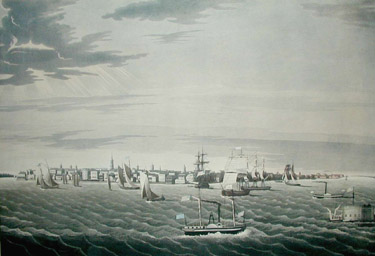
Handsome and exceedingly rare view of Charleston -- one of the important seaports of the United States in the Federal Period. The print was engraved and published by William Keenan, a native of Charleston, based on a drawing by Charles Blacker Vignoles, an English army officer. Vignoles arrived in Charleston in 1817, served as assistant surveyor general of the state, and returned to England in 1823, the presumed dates of the view.
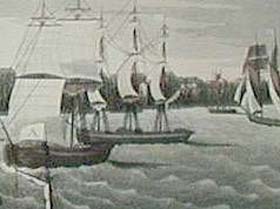
The view shows an active seaport with numerous boats in the foreground and the city in the distance bathed by sunrays emerging from clouds. Numerous landmarks are shown including St. Michael's Church, a tall steeple to the left of center, and St. Philip's Church, the cupola in the center, later destroyed by fire in 1835. Castle Pinckney, a Charleston landmark, is shown offshore to the far right.
Stokes records only two examples of this print, also printed in sepia, including one in the New York Public Library. References: Stokes P.1817-23-E-62, Stauffer vol. 1, p.149, Deak, No. 308.
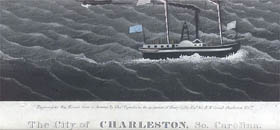
Inscription in lower margin: "Engraved by Wm. Keenan from a drawing by Chas. Vignoles in the posession [sic] of Henry Ogilby Esqr. his B.M. Consul Charleston So. Ca."
The following is a description of an example of this print in the collection of the New York Public Library. The description is quoted verbatim from Gloria Gilda Deak, Picturing America (Princeton University Press: 1989).
No. 308
The City of Charleston, So. Carolina.
Engraved by WM. Keenan From A Drawing by Chas. Vignoles In the Posession [sic.] of Henry Ogilby Esq. His B.M. Consul Charleston So. Ca.
Published by Wm. Keenan Engraver 132 King St. Charleston S.C.
Aquatint, printed in sepia. Size (image): 16 7/8 X 24 9/16 inches; 429 X 624 mm. Date depicted: 1817-1823. Date issued: ca.1837, or possibly earlier. Artist: Charles Blacker Vignoles. Engraver: William Keenan. References: Francis W. Bilodeau and Mrs. Thomas J. Tobias, eds., Art in South Carolina 1670-1970, Charleston, 1970, pl. 116. Collection: Stokes, P.1817-23- E- 62.
Charleston's architectural profile has been given its status of America's most beautiful antebellum city. It had an early start in acquiring this status: its location on the coast, its climate, the fertility of the surrounding regions, and its cultural link with the founding of the nation all fed into its development as a favored city. Handsome buildings continued to be built here and in other centers of the state well into the third decade of the nineteenth century. "But after about 1835, when settlers began to head from the old states of the coastal south to the fertile New Lands of the Mississippi Valley," writes Mills Lane, "South Carolina's architecture declined in quality." During the period depicted in the aquatint, however, Charleston was still one of the new republics great cities: its wealth had not yet been dwarfed by the steady rising fortunes of Boston and New York. The seacoast city enjoyed the conspicuous talents of the architect Robert Mill, a native Charlestonian encouraged in his career by Thomas Jefferson. Mills designed several of Charleston's important buildings, as well as proposing canals, reclamation of swamplands, and many kinds of public works for the benefit of the city as well as for the state.
In the aquatint, we see Charleston from across the Cooper River. The tallest steeple to the left of center belongs to St. Michael's Protestant Episcopal Church, built from 1752 to 1761 and still standing. The stout cupola to the right of it, farther back from the water, is that of the First Congregational Church, designed by Mills and opened on May 25, 1806. Mills received the commission to design the church (his major assignment in Charleston) when he was twenty-three years old. He drew inspiration from the Pantheon for his conception, and the building was commonly known as the circular church. The handsome structure underwent modifications in 1838 and 1853; in 1861 it was destroyed by fire. A building close by, also designed by Mills but not visible in the view, is the Public Record Office on Meeting Street, conceived in a simple Greek Doric style by the architect in 1821. Still standing, and known more popularly as the Fire Proof Building, it now houses the South Carolina Historical Society. The cupola in the center of the view (just left of the double-masted ship's rigging) is St. Philips Episcopal Church opened in 1723 and destroyed by fire in 1835. At the extreme right of the aquatint is Castle Pinckney, the round bastion with unfurled flag. Begun in 1797 and named in honor of Charles Cotesworth Pinckney, ambassador of France, the castle was destroyed by a gale in 1804. It was rebuilt in 1810 and stands today as a harbor land mark. Although never active in defense of the city as intended, it was used constantly by government agencies; during the civil war, for example, it served as a prison for captured Federal soldiers.
The depiction of Charleston reflects a combination of trained and untrained artistic techniques. Compositional elements are effectively unified, while large canvas of sky is relived by the conventional device of sun breaking through the clouds. Bright rays illuminate the city's water front profile in the middle distance where buildings are crisply delineated. But throughout there is a certain stiffness as well as a flawed sense of scale. Nor are the waters of the Cooper River -- where two steamboats can be seen making an early appearance along with vessels under sail -- convincingly projected. Whether the skill is attributable to the artist and the naiveté to the engraver is moot.
The artist Charles Blacker Vignoles, an English Army Officer, crossed the Atlantic to enter the service of the South American liberator Simon Bolivar but soon went to Charleston, arriving late in the fall of 1817. Shortly thereafter he was appointed assistant surveyor general of the state, and he served in that capacity for the next two or three years. He also prepared a considerable number of private surveys in both South Carolina and Florida. Robert Mills, in his Atlas of the State of South Carolina (1838?), reproduces two of them. In the 1823, Vignoles returned to England and published there his Observations on the Floridas, accompanied by his map of that region. Thereafter he became one of his country's leading engineers, specializing in railroad construction, and shortly before his death he was elected President of the Institution of Civil Engineers. His career is recounted by O.J. Vignoles in his Life of Charles Blacker Vignoles.
William Keenan, the engraver, was born in Charleston around 1810 and worked in Philadelphia from 1830 to 1833. He is listed as an engraver in Charleston city directories from 1837 to 1859.