Rufus Wright (1832 -1900) (after)
City of Davenport, Iowa: From the Original Picture in the Possession of Geo. L. Davenport
Sarony, Major & Knapp, 449 Broadway, New York: c. 1858
Hand-colored lithograph
22.25 x 29.75 inches, overall
Sold, please inquire as to the availability of similar items.

Davenport, Iowa
Scarce 19th Century View
Scarce 19th Century View
This item is sold. It has been placed here in our online archives as a service for researchers and collectors.
- Please inquire as to the availability of similar items currently in stock, or use the navigation bar above to browse our site for currently available items.
- Find guidelines for the use of images from georgeglazer.com.
- To see more archived items, view our directory.
- Find information about selling your art and antiques.

 |
 |
 |
 |
 |
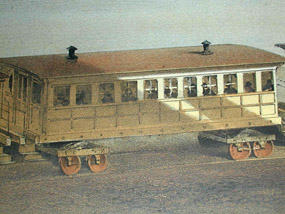 |
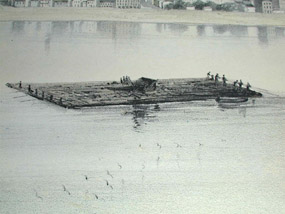
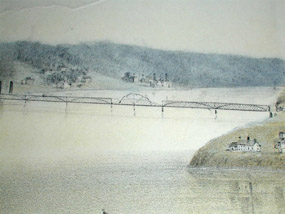
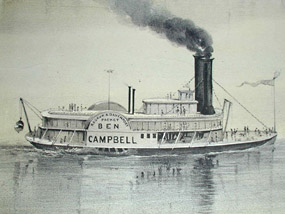
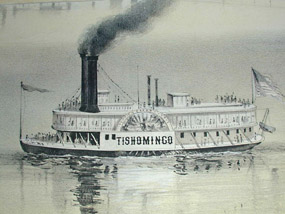
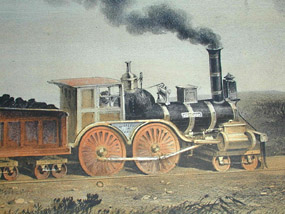
Scarce important bird's-eye view showing Davenport, Iowa, based upon a renowned painting then in the possession of George L. Davenport, after whom the city was named. The city is seen as a growing metropolis, with houses and factories with active smokestacks from the opposite bank of the Mississippi River. The first bridge across the Mississippi, built in 1858, is shown in the far right of the image. A steam locomotive train appears in the foreground pulling two freight cars and two cars of passengers. A barge is in the river, along with several boats, including the steamboats Tishomingo and Keokuk & Davenport Packet Ben Campbell. A list of population counts in the lower margin documents the striking growth of the city over a 22-year period, from a tiny town of 60 people in 1836, to 16,677 residents in 1858.
According to Gloria Gilda Deák, the image by Rufus Wright was also made into a different print as a frontispiece foldout in the book Davenport Past and Present by F.B. Wilkie, published in 1858 (not a separately issued folio print such as the one we offer). In Picturing America, Deák also describes a slightly earlier view of Davenport, c. 1855-1857 (Item 715), based on a painting by E.P. Gillett, now in the collection of the New York Public Library. Deák notes that the two views have similarities, however, "The one conspicuous difference is the inclusion in the Wright view of the first bridge across the Mississippi. The bridge was completed in 1858, a short time after the Library's [Gillett] lithograph must have been drawn."
Davenport was established in an area known as the "Black Hawk Purchase" and named after Colonel George Davenport. The city grew with retail and wholesale commercial sales comprising a majority of its economy. The Mississippi River still rises annually, and often causes significant damage, but access to the river is of such importance for trade that the city has constructed no permanent levee or flood protection. Buffalo Bill Cody and actress Lara Flynn Boyle are both famous natives of the city.
The period from after the Civil War to about 1910 was the heyday of promotional bird’s-eye views of American towns. Historians estimate that some 4,500 views were produced nationwide during this period. In an era before aviation, the creation of these panoramas was an act of imagination, combining information from city maps, ground-level sketches of buildings and the rules of Renaissance perspective into a convincing aerial view. Some of these views were commissioned to promote settlement and development of towns, especially as part of the Westward Expansion of the United States, but they were also purchased by residents as emblems of civic pride. Hand-drawn views were largely supplanted by aerial photographs in the 20th century.
Rufus Wright studied at the National Academy of Design and under George Augustus Baker, Jr. in New York City. He worked as a portrait, genre and still life painter, as well as a lithographer. Evidently he made a trip west during the 1850s for Sarony, Major & Knapp, where he drew this view of Davenport, among his well-known works. He is also noted for his portraits of 19th-century political figures. By 1860, he was living in New York City, where he spent most of his career, and taught at the Brooklyn Academy of Design from 1866 to 1872. After 1875, he concentrated on genre paintings. His works are in several museum collections, including the Yale University Art Gallery and New York Historical Society.
Sarony, Major & Knapp was a New York lithography firm from 1857 to 1867, a partnership between Napoleon Sarony (1821-1896), Henry B. Major and Joseph F. Knapp. Sarony was an expert craftsman and a charismatic and gifted entrepreneur. Born in Quebec, he came to New York in 1836 and made his mark working for Nathaniel Currier before joining Major to form their own business in 1846. They were joined by Knapp in 1857. Sarony was the leader, supplying ideas, finding artists and drawing most of the portraits. He withdrew from the firm in about 1867 to set up successful photographic studios in New York and Europe, where he lived for several years. Sarony, Major & Knapp was a large firm operating 40 presses by 1859. They were prolific publishers of book illustrations, prints for government reports, medical and scientific plates, theatrical portraits, music sheets, maps and views.
Deák further gives an impression of Davenport of this period by quoting from page 120 of Wilkie's 1858 guide, touting Davenport as a vibrant stable industrial city:
It speaks well for the character of Davenport, that the foundations of her prosperity were never on paper, but were laid deep and permanent in the Industry of her inhabitants. The growth of the town has always been concomitant with the settling of the back country, the establishment of manufacturing interests, and the development of other resources. There has been at no time a retrogression, or a stand-still, indicating a fictitious progress, or an over-growth. Thus, in 1854, the population increased nearly or quite three thousand. The base of this growth was the railroad connection, six saw mills, turning out from twenty to thirty thousand feet of lumber each per day; two foundries and machine shops; some twenty-four run of burrs, dozens of smith and wagon shops, one wholesale plow factory, turning out one hundred plows per week, one Pork packing establishment, and a County population of about thirteen thousand. In these statistics will be recognized a solid and lasting base of prosperity, not to be quashed as a speculative bubble, or destroyed by a financial 'crisis.'
References:
"Davenport, Iowa." Wikipedia. 30 June 2003. http://www.wikipedia.org/wiki/Davenport,_Iowa (26 August 2003).
"Davenport, Iowa History." Americatravelling.net. 2000. http://www.americatravelling.net/usa/iowa/davenport/davenport_history.htm (26 August 2003).
Deák, Gloria Gilda. Picturing America. Princeton University Press: 1989. Item 715, pp. 486-87.
Groce, George C. and Wallace, David H. The New-York Historical Society's Dictionary of Artists in America 1564-1860. New Haven: Yale University Press, 1969. p. 706.
Peters, Harry T. America on Stone. U.S.: Doubleday, Doran, 1931. pp. 350-356.