Claude Lorrain (1604-1682) (after)
François Vivares (1709-1780) (engraver)
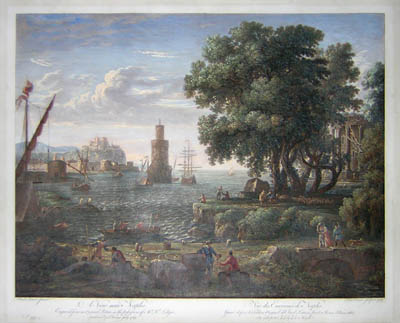
A View near Naples, No. 29
François Vivares, Paris: July 1769
Hand-colored engraving (possibly with etching)
20.5 x 25.75 inches, overall
19.5 x 24 inches, plate mark
33 x 37 inches framed
Sold, please inquire as to the availability of similar items.

A View near Naples
François Vivares after Claude Lorrain
François Vivares after Claude Lorrain
This item is sold. It has been placed here in our online archives as a service for researchers and collectors.
- Please inquire as to the availability of similar items currently in stock, or use the navigation bar above to browse our site for currently available items.
- Find guidelines for the use of images from georgeglazer.com.
- To see more archived items, view our directory.
- Find information about selling your art and antiques.
 |
 |
 |
 |
 |
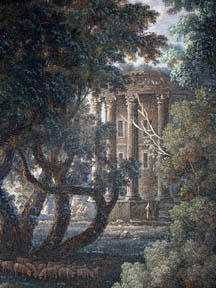
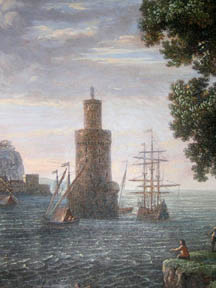
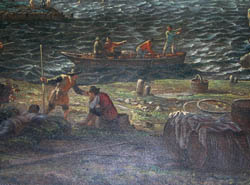
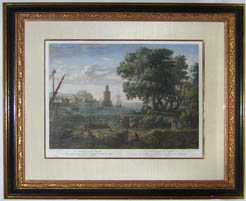
View near Naples based on a painting by the Old Master painter Claude Lorrain. Boats lay anchor around a lighthouse in the middle of a bay overlooked by a walled castle. People unload their goods onto the shore in shimmering sunlight and gather beneath a large tree situated in front of classically inspired architecture. The print is titled in English and French, and according to an inscription is based on the original painting owned by Mr. Robert Ledger. It is in a gilt frame decorated with laurel leaves.
Claude Lorrain was a French painter, draftsman and etcher. Born Claude Gellée, he became known as “le Lorrain” after his native Lorraine, France. He was active in Italy from 1617, known especially for his idealized landscape paintings, pastoral images that presented a refined and orderly version of the beauty of nature. This genre had emerged in Venetian painting around 1510, and Lorrain developed it through his attention to light as a way to unify his pictorial compositions. He made drawings from nature constantly to fuel his imagination. These elegant works appealed to members of the European aristocracy and higher clergy who were his patrons. He also painted genre scenes after mythological and Biblical subjects. Lorrain’s work was widely disseminated through prints of his work, in collections such as Liber Veritatis, with engravings by Richard Earlom, published in England by John Boydell in the late 18th and early 19th centuries. His work influenced the development of landscape engraving, as engravers such as Woollett and Vivares endeavored to capture the subtle tonal gradations of his paintings. Lorrain’s works are in the collections of the major world museums such as the Hermitage, Louvre and Metropolitan Museum of Art.
François Vivares was a French-born engraver and print publisher active in England, where he was one of the founders of the English school of landscape engraving. His family came to London in 1711. There he learned engraving with Joseph Wagner and was producing prints by 1739. His ornament books helped to introduce the Rococo style to England from circa 1740 to 1760. He also engraved landscape prints after Old Master painters such as Claude Lorrain and by English and foreign contemporaries such as Gainsborough, Thomas Smith of Derby and Claude-Joseph Vernet. In the 1750s and 1760s he also engraved and published decorative borders for use in print rooms, an 18th century form of interior decor where prints were glued directly to the wall. Between 1766 and 1768 he exhibited landscape prints after Claude and Vernet with the Society of Artists. Today his works can be found in museums such as the Fitzwilliam Museum in Cambridge.
References:
“Claude (le) Lorrain.” The Grove Dictionary of Art. New York: Macmillan. 2000. Online at Artnet.com. http://www.artnet.com/library/01/0180/T018011.asp (22 November 2004).
“François Vivares.” The Grove Dictionary of Art. New York: Macmillan. 2000. Online at Artnet.com. http://www.artnet.com/library/08/0899/T089957.asp (22 November 2004).
“Line Engraving.” LoveToKnow 1911 Online Encyclopedia. 2003-2004. http://20.1911encyclopedia.org/L/LI/LINE_ENGRAVING.htm (22 November 2004).